



































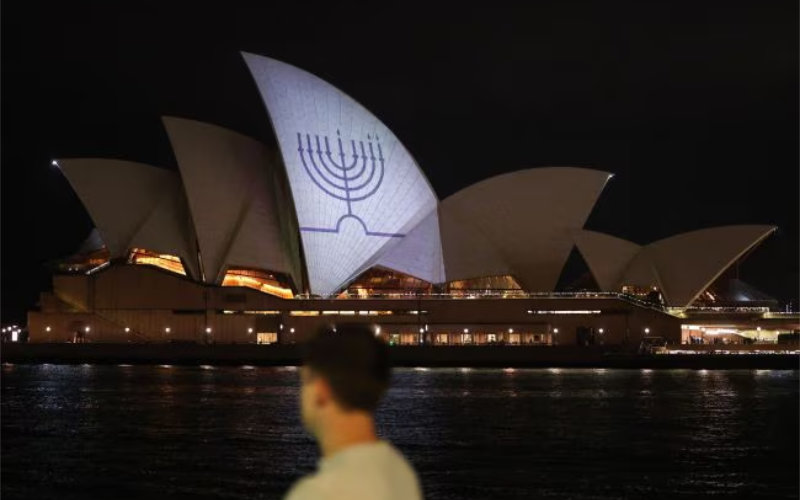
Australia’s recent public mourning events have sparked intense debate about the nation’s approach to grief, particularly highlighting a perceived hierarchy that prioritizes some communities over others. On a Thursday night at the iconic Sydney Opera House, political leaders, including the Prime Minister and state premiers, gathered to express collective sorrow over the loss of fifteen individuals. Clad in solemn attire with kippahs, they participated in what some observers have called a masterclass in performative grief. This display, however, raises critical questions about the nature of empathy and whose suffering is considered worthy of national recognition.
The intense public response to these deaths has not emerged in isolation. Vigils, ceremonies, and gatherings at locations like Bondi Beach have dominated media coverage, with front pages dedicated to the tragedy for weeks. Yet, this overwhelming expression of mourning contrasts sharply with the experiences of Australia’s Aboriginal population. Approximately 750,000 to 800,000 Aboriginal Australians have historically faced significant barriers to public mourning, particularly on January 26, a date they regard as one of invasion and dispossession. When they voice their grief, they are often met with dismissive reactions, accused of being unpatriotic or divisive.
This discrepancy in the public response to grief highlights a rigid hierarchy that determines whose pain is acknowledged. While the Jewish community in Australia, comprising roughly 90,000 individuals, received widespread and uninterrupted national mourning, Aboriginal Australians find their requests for recognition met with resistance. The contrasting treatment is illustrative of broader societal attitudes, where Aboriginal mourning is framed as a political challenge rather than a legitimate expression of sorrow.
The media landscape, particularly News Corp Australia, has played a crucial role in shaping public perception. It has established a narrative that sanctifies certain forms of grief while undermining others. Jewish mourning is often presented as a moral imperative, whereas Aboriginal mourning is portrayed as an attack on national identity. This bias raises essential questions about the symbols of mourning that are publicly recognized. For instance, flags are lowered for foreign nations, yet Aboriginal flags remain unacknowledged on their day of mourning.
Aboriginal Australians, who have been the custodians of the continent for tens of thousands of years, have advocated for recognition of their history through initiatives like the Uluru Statement from the Heart. This statement requests a modest yet significant reform—a Voice to Parliament that would allow them to participate in discussions about laws affecting their lives. Despite broad public consultation, this proposal was rejected decisively in a national referendum. In stark contrast, a special envoy for Jewish Australians was appointed without public consultation, leading to immediate policy changes regarding funding, visas, and academic matters.
The implications of these actions reveal a troubling double standard in how different communities are treated. While Jewish Australians are granted institutional power through ministerial decree, Aboriginal Australians are left to navigate a system that views their voice as optional. The disparity highlights a fundamental issue within Australian society: the ability to mourn and seek recognition is not equally distributed.
Moreover, many individuals mourning publicly for the Jewish community also express a dual allegiance to Israel. This aspect of identity complicates the national narrative, as Australia publicly lowers flags and engages in collective mourning for international events while neglecting its own First Nations peoples. Aboriginal Australians observe the fervent national grief for foreign losses juxtaposed against a lack of recognition for their own historical suffering.
The situation raises significant concerns about the values of unity and empathy in Australia. Many Aboriginal Australians perceive the current approach to mourning as a reflection of moral cowardice, where the political and media classes prioritize optics over genuine compassion. This selective empathy is seen as a failure to acknowledge the shared history and pain that exists within the nation.
In conclusion, until Australia applies equal standards of grief, symbolism, and institutional respect to its Aboriginal population, calls for unity ring hollow. The ongoing disparities in how different communities are allowed to mourn reflect deeper societal issues that require honest engagement. Understanding and addressing these disparities is crucial for a more inclusive and empathetic national narrative.
