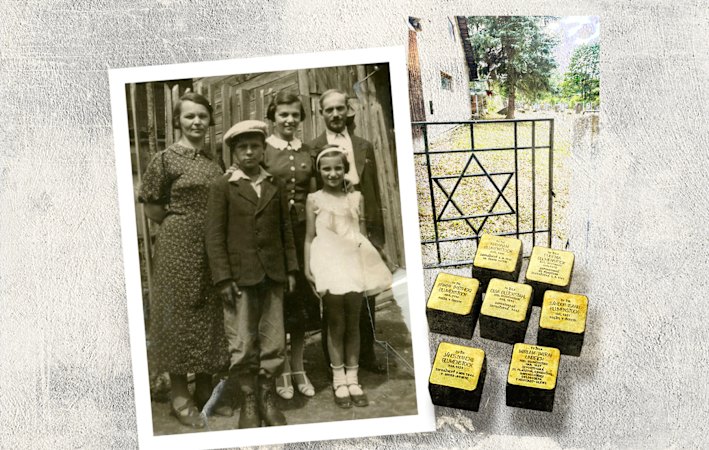
In a poignant journey of remembrance, Rachelle Unreich and her sisters visited their late mother’s hometown of Spisska Stara Ves in Slovakia to honour their family’s tragic past during the Holocaust. Their mission involved laying memorial stones, known as Stolpersteine, to commemorate their grandparents and relatives, of whom five were captured by the Nazis. Only their mother, Mira Blumenstock, survived the harrowing ordeal.
The sisters arrived in August, finding a pastoral village set against the Tatras mountains, just as their mother had described. The town, with its gothic 14th-century church and modest homes, captured their imagination, but the visit was not for leisure. They gathered with relatives from various parts of the world to pay tribute to a family history marked by loss and resilience.
On September 3, 1944, the Blumenstock family faced a devastating night when Nazis raided their home, believing that Jewish families remained in the area. Of the original 300 Jewish residents before the war, only eight families remained. The raid resulted in the capture of Mira’s mother, Genya, and her younger brother, Yanchi. Tragically, Genya was executed shortly after their arrest, and Yanchi was killed in another camp. Mira, just a teenager, endured four concentration camps, including the notorious Auschwitz.
To honour their family, the sisters chose to lay seven Stolpersteine, small brass memorial blocks engraved with the names and fates of their relatives. This initiative is part of a larger project initiated by artist Gunter Demnig, with over 116,000 stones placed across Europe to commemorate victims of the Holocaust. The stones serve not only as memorials but as a reminder of shared humanity, encouraging passersby to stop and reflect on the stories behind the names.
During the ceremony, attended by local townspeople, Mayor Jan Kurnava delivered a heartfelt speech emphasizing the importance of remembering those who suffered. He stated, “The stones give a voice to those whose voices were taken away… Their names belong to the history of our town, and their stories are part of our shared memory.” The gathering included a 90-year-old man who recalled the day of Dolfie’s death, a moment that resonated deeply with the sisters.
The visit also took them to the Jewish cemetery, where Dolfie’s gravestone stands in stark contrast to many weathered and fallen tombstones. This solemn site is a reminder of the enduring pain of loss, yet it also represents the strength of memory. Unreich and her sisters faced some apprehension about their journey, given the historical weight of the places they were visiting.
In Poland, the sisters visited both Plaszow and Auschwitz, where they sought to gain a deeper understanding of their mother’s experiences. While Plaszow is now part of a museum, traces of its past remain, providing significant insights into the scale of suffering endured there. The sisters discovered the site where Genya met her tragic fate, a powerful moment that allowed them to connect with their family history in a deeply personal way.
At Auschwitz, the scale of the horror was overwhelming. The conditions under which prisoners lived were starkly visible, particularly in Block 11, where inmates faced unimaginable suffering. Unreich reflected on her mother’s youthful spirit and vitality, contrasting with the horrors of the camp. On a symbolic gesture of defiance, she placed her book, A Brilliant Life, which recounts Mira’s story, against one of the barracks. In that moment, she felt the triumph of her mother’s survival and the enduring legacy of her life.
The journey culminated in a broader reflection on Holocaust remembrance. As the sisters laid the Stolpersteine, they embraced the dual purpose of remembrance: to honour the pain of the past while celebrating the resilience and beauty of their mother’s life. They recognised that Holocaust remembrance is not only about ensuring that the atrocities are never forgotten but also about cherishing the rich heritage and pride of those who survived.
International Holocaust Remembrance Day, observed on January 27, serves as a reminder of these narratives. Unreich’s journey highlights the importance of remembering not only the tragedy but also the joy and strength that defined her mother’s life. The act of remembrance, as she has discovered, is a powerful way to ensure that the light of those who suffered continues to shine brightly against the darkness of history.