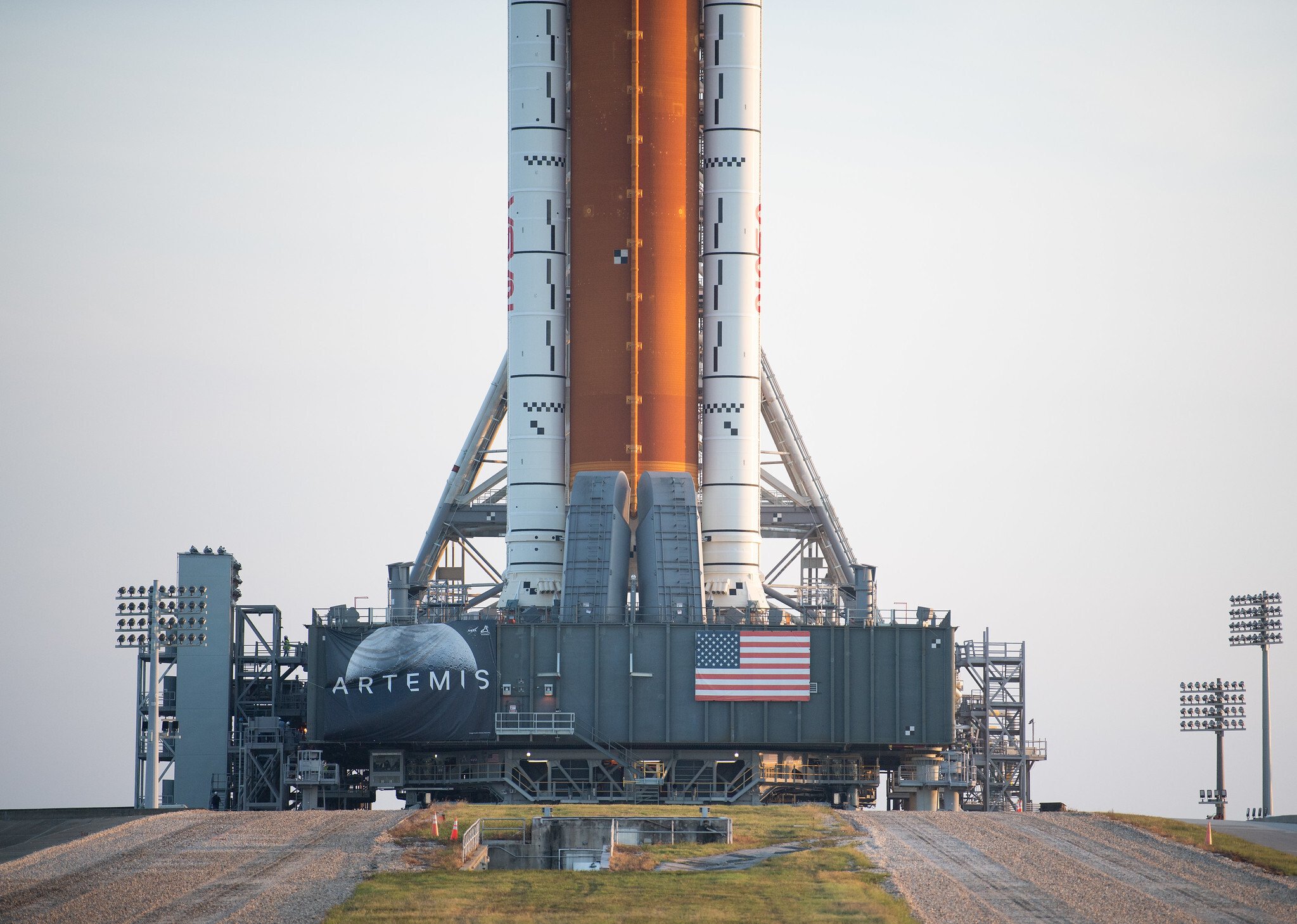
NASA’s Space Launch System (SLS) and the Orion spacecraft are set to embark on a significant journey to their launchpad in Florida, marking a major milestone for the upcoming Artemis II mission. This mission, scheduled for launch on January 17, 2024, will be the first crewed lunar flight in over 50 years, aiming to send astronauts into deep space.
The rollout from the Vehicle Assembly Building at Cape Canaveral will commence early Saturday, with the rocket transported on a crawler-transporter at a speed of just under 1 mph. Launch director Charlie Blackwell-Thompson stated that the journey to the launchpad will take approximately eight to ten hours. Once the SLS reaches its destination, teams will connect the rocket and capsule to ground systems and prepare for the final series of ground tests. If all goes well during the fueling dress rehearsal, launch opportunities could arise as soon as February 2024.
Key Facts About the Space Launch System
The SLS is indeed a powerful rocket, generating about 8.8 million pounds of thrust, comparable to approximately 160,000 Corvette engines. However, it is no longer the most powerful rocket in operation. SpaceX’s Starship has surpassed SLS, producing an estimated 16 to 17 million pounds of thrust. Although the SLS claimed the title of the most powerful rocket during its Artemis I debut, Starship has successfully completed multiple tests in space. Notably, the SLS is flight-ready for astronauts, while Starship has yet to carry any payloads.
The SLS measures 322 feet in height, making it taller than the Statue of Liberty and Big Ben. While it surpasses the height of the Space Shuttle stack, it still trails behind the Saturn V, NASA’s Apollo-era rocket. Starship, on the other hand, towers over SLS by more than 80 feet.
Unique Features of SLS and Orion
Currently, the SLS is the only rocket capable of transporting the Orion spacecraft to the moon and beyond. For Artemis II, the Orion capsule, now named Integrity by the crew, will serve as both a spacecraft and a living space for the astronauts. The mission will take the capsule approximately 5,000 miles past the moon’s far side, potentially setting a new distance record for human spaceflight. After the mission, Orion is expected to splash down in the Pacific Ocean.
The design of SLS incorporates significant elements from the Space Shuttle program, which operated from 1981 to 2011. Engineers used major shuttle hardware, modifying the shuttle’s orange external tank to form the rocket’s core stage while utilizing four engines from the shuttle program. Unlike previous missions, these engines will not be reused and will be discarded after flight. Two solid rocket boosters, derived from the shuttle, flank the core and contribute approximately 75 percent of the thrust at liftoff.
To adapt the SLS for lunar missions, engineers made several modifications that sacrificed reusability for enhanced performance. Features such as parachutes and landing sensors were removed to increase payload capacity. This allowed Orion to achieve speeds of around 24,500 mph, which are required for a lunar trajectory. Although this design prioritizes performance, it also means that new boosters and engines are used for each launch.
SLS has garnered the nickname “America’s rocket,” reflecting its status as a national asset. Cost considerations were not the primary focus during its development. A spending law enacted in 2010 mandated the construction of the rocket, specifying design and contractor details to protect jobs during the Great Recession. Today, about 3,800 suppliers across all 50 states contribute to the SLS and Orion programs. NASA’s inspector general estimated that the cost for each Artemis launch could reach $4.1 billion, with roughly half attributed to the SLS alone.
As the rollout approaches, the excitement surrounding Artemis II continues to build, promising a new chapter in human space exploration.