


































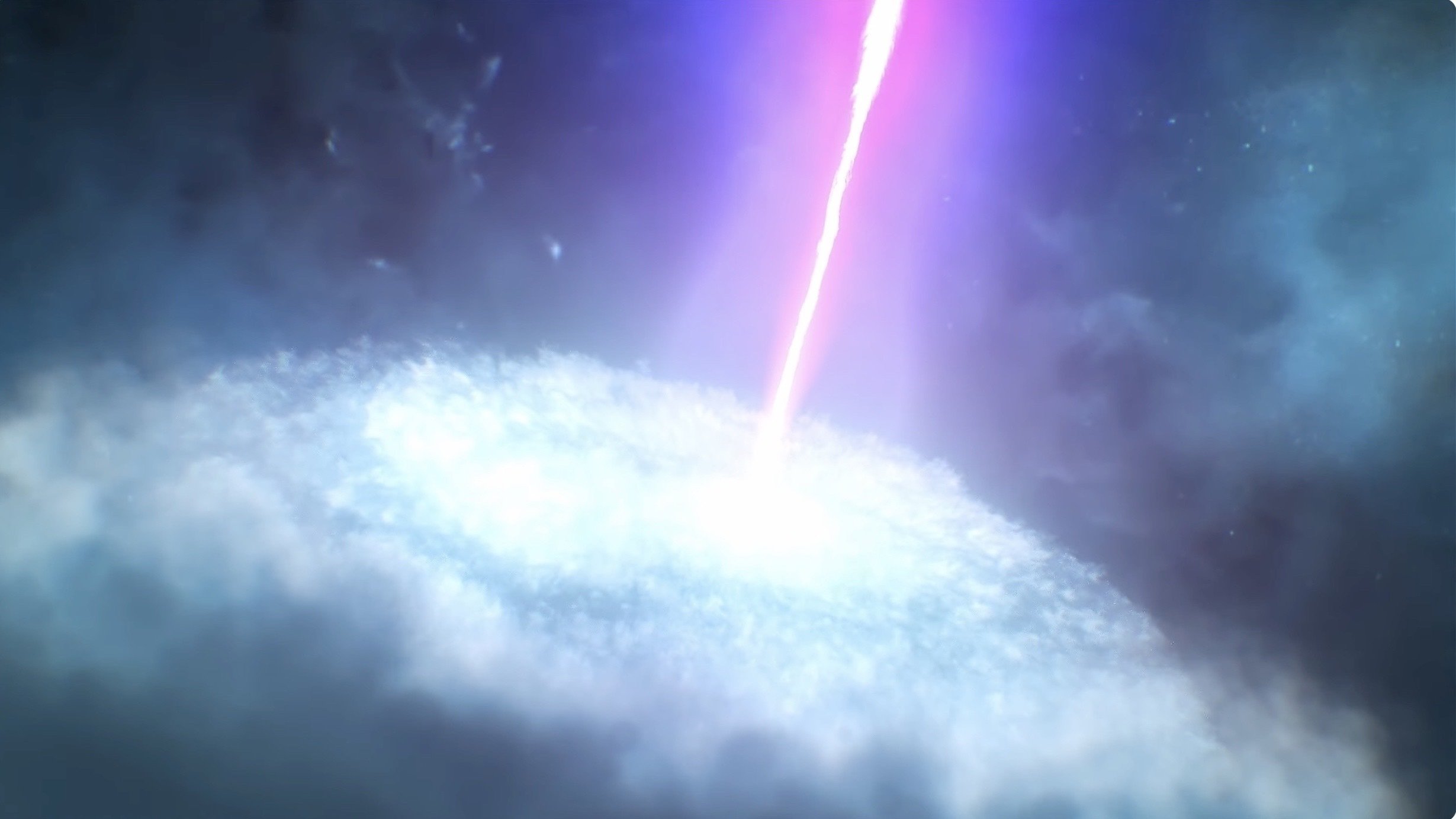
A remarkable cosmic explosion was detected on July 2, 2023, marking it as the longest and most unusual gamma-ray burst ever observed. This event, designated as GRB 250702B, defied conventional understanding of gamma-ray bursts, which typically last only seconds or minutes. These powerful explosions are usually triggered by the collapse of massive stars or the collision of neutron stars. However, this particular outburst lasted for days, prompting scientists to investigate its implications for black hole behavior.
The explosion was detected by a collaboration of satellites, including NASA’s Fermi and Swift telescopes, along with other instruments across various spacecraft. Researchers pieced together data from multiple observatories to capture the entirety of this extraordinary event. “This is certainly an outburst unlike any other we’ve seen in the past 50 years,” stated Eliza Neights, a researcher at George Washington University.
Unraveling the Mystery of GRB 250702B
Follow-up observations traced the origin of GRB 250702B to a galaxy approximately 8 billion light-years away. This means the explosion occurred long before the formation of Earth. Images from the James Webb Space Telescope and other instruments provided a unique view of the host galaxy, revealing its intriguing structure. According to Andrew Levan, an astrophysics professor at Radboud University, the galaxy is likely either two galaxies merging or a single massive galaxy obscured by a dark band of dust.
The energy released by the explosion was equivalent to that of 1,000 suns shining for 10 billion years, all within a span of just a few days. The initial burst lasted for at least seven hours, significantly exceeding the duration of any previous gamma-ray bursts. “The resolution of Webb is unbelievable,” remarked Huei Sears, a researcher at Rutgers University. “We can see so clearly that the burst shined through this dust lane spilling across the galaxy.”
New Theories on Black Hole Behavior
The findings regarding GRB 250702B suggest new theories about black hole activity. Most scientists concur that the prolonged explosion likely resulted from a black hole consuming a star. However, two alternative scenarios are still under consideration. One proposes that a medium-sized black hole, thousands of times more massive than the sun, tore apart a wandering star before swallowing it. The second scenario involves a smaller black hole orbiting a nearby companion star, siphoning gas over time until it plunged into the star itself.
In both scenarios, gas stripped from the star would accumulate into a superheated disk around the black hole, producing narrow jets of energy traveling at nearly the speed of light. These jets are responsible for the gamma-ray glow detected from Earth.
GRB 250702B exhibited characteristics that challenge existing models of gamma-ray bursts. Notably, X-ray emissions appeared a full day before the main explosion and continued for two days after, a behavior not typically observed in standard gamma-ray events. Furthermore, no distinct supernova was detected, which is usually the bright remnant of collapsing stars. These peculiar details strongly indicate that scientists may be witnessing a new category of cosmic explosion.
Further research and observations will be crucial for understanding GRB 250702B and its implications for our knowledge of the universe. The findings related to this extraordinary event will be published in the Monthly Notices of the Royal Astronomical Society, while additional insights have already been shared in The Astrophysical Journal Letters. Scientists are eager to capture more instances of such phenomena to refine their understanding of cosmic explosions and black hole behavior.