



































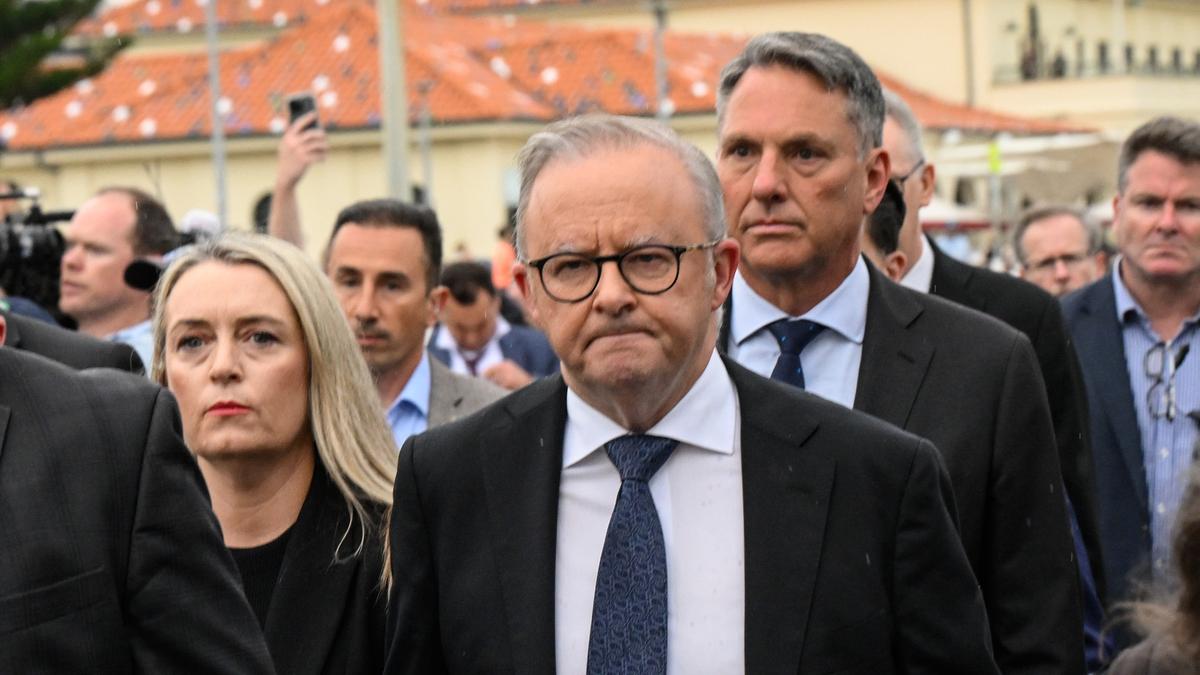
URGENT UPDATE: Tensions peaked at the National Day of Reflection Service on Sunday night as Prime Minister Anthony Albanese was met with boos and jeers, underscoring a growing rift with the Jewish community following the tragic shooting at Bondi Beach that claimed 15 lives. In stark contrast, NSW Premier Chris Minns received a standing ovation for his decisive and compassionate response to the crisis.
The rally, intended to honor the victims of the horrific attack during a Hanukkah celebration, became a platform for expressing frustration towards Albanese’s perceived inaction on rising antisemitism in Australia. Attendees openly declared that the Prime Minister was unwelcome, a sentiment echoing the community’s demand for immediate action in the wake of the tragedy.
Premier Minns has swiftly taken proactive measures, vowing to amend hate speech laws and proposing a state Royal Commission to address the surge in antisemitic incidents. His commitment includes toughening the definition of hate speech and addressing dangerous rhetoric such as the chant “Globalise the Intifada.” His actions resonate deeply with a community shaken by violence and mourning the loss of innocent lives, including a Holocaust survivor and a ten-year-old girl.
“Unity cannot be commanded; it is earned through action,” Minns stated, highlighting the importance of leadership in times of crisis.
Meanwhile, Albanese’s response has drawn criticism as insufficient. His initial proposal for stricter gun laws, reminiscent of former Prime Minister John Howard‘s reforms following the Port Arthur massacre, has been dismissed by many as a diversion. Critics argue that his belated acknowledgment of growing antisemitism has further alienated federal Labor from the Jewish community, which is seeking accountability and meaningful action.
At the service, Albanese was flanked by security and supportive Cabinet members, further illustrating the strained relationship with attendees. Reports confirm that he was booed upon entering and leaving the venue, a stark visual representation of his disconnection from the community he aims to unite.
Amidst growing calls for an inquiry into the attack, ASIO Director-General Mike Burgess acknowledged the agency’s shortcomings in preventing the tragedy but emphasized the absence of an intelligence failure. He stated, “Tragically, we did not know about the attack before it happened. It weighs on us heavily.” However, many argue that this does not excuse a lack of proactive measures to prevent such violence.
Community leaders, including David Ossip from the NSW Board of Deputies, have publicly criticized Albanese’s decision to conduct only a review of intelligence bodies rather than a comprehensive federal Royal Commission. “We need a royal commission that goes beyond New South Wales to get to the bottom of how this catastrophe took place,” Ossip asserted during the memorial.
The Prime Minister’s absence from funerals and other community events has not gone unnoticed, further fueling the perception that he is out of touch with the needs of the Jewish community. His failure to engage directly has compounded frustrations, particularly as Minns has actively participated in mourning events and community gatherings.
As the nation grapples with the aftermath of this tragedy, the divide between Albanese and the Jewish community deepens. Calls for a federal inquiry into antisemitism and violence continue to grow louder, pressuring the Prime Minister to take more decisive action.
WHAT’S NEXT: With public sentiment shifting, the spotlight remains on Albanese to respond meaningfully to the crisis. Observers will be watching closely to see if he heeds the community’s call for an inquiry and whether he can rebuild trust with a community that feels overlooked and abandoned in its time of need.
