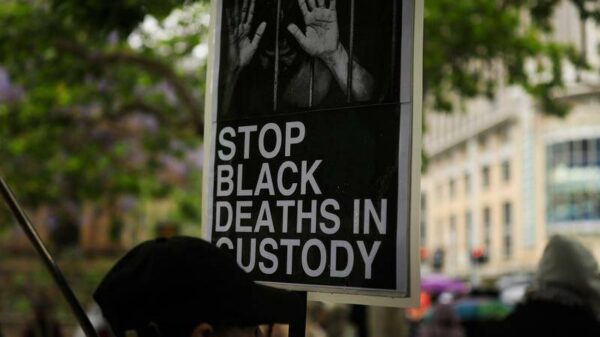
































UPDATE: New data reveals that Indigenous deaths in custody have reached a shocking 45-year high, with 33 Aboriginal and Torres Strait Islander people losing their lives in custody during the 2024/25 period. This alarming statistic marks the highest number since 1979/80, bringing the total deaths to 617 since the landmark 1991 Royal Commission into Aboriginal Deaths in Custody.
Advocates are sounding the alarm, stating that political maneuvering is costing lives. The acting chair of the National Aboriginal and Torres Strait Islander Legal Services, Nerita Waight, emphasized the correlation between rising incarceration rates and the grim death toll. “There are more Aboriginal and Torres Strait Islander people in prison now than ever before,” Waight said, condemning the policies that prioritize political gain over human lives.
Independent senator Lidia Thorpe condemned the situation, labeling it a “national disgrace.” She stated, “In these horrific figures, I see violent colonialism perpetrated by hollow politicians desperate for votes and power. How many more of our people do we need to bury before governments stop sacrificing our lives for political gain?”
The Australian Institute of Criminology reported that New South Wales recorded its highest number of Indigenous deaths in custody in 45 years, with nine deaths in 2024/25 alone. State coroner Teresa O’Sullivan noted that the number of Indigenous deaths in NSW prisons reached 12 by October 2025, calling it a “profoundly distressing milestone.”
Research highlights that Indigenous people accounted for 29 percent of all deaths in custody, an increase from 23 percent in the previous year—the highest proportion since 2002/03. Despite making up only about four percent of Australia’s total population, they represent over a third of the prison population.
Among the 90 deaths in prison custody during this period, 26 were Aboriginal or Torres Strait Islander individuals. Additionally, one death occurred in youth detention, and of the 22 deaths in police custody, six were Indigenous. Over 40 percent of these deaths involved individuals who had not yet been sentenced.
The study also revealed alarming trends in the causes of death. Of the 19 deaths in prison custody for which the cause was known, an equal number were attributed to natural causes and self-inflicted injuries. This represents the highest number of self-inflicted Indigenous deaths in custody since 1979/80. Dr. Samantha Bricknell, research manager at the Australian Institute of Criminology, noted the increasing pattern of self-inflicted deaths, particularly among those on remand.
The Royal Commission into Aboriginal Deaths in Custody made 339 recommendations in 1991 aimed at preventing such tragedies. Among these was a call to remove hanging points from cells, a recommendation that remains largely unaddressed more than three decades later. Waight criticized the lack of action, stating, “It is utterly unacceptable that we are still waiting for governments to implement the recommendations of the royal commission.”
In a stark reminder of the urgency, she added, “At least 75 percent of Aboriginal and Torres Strait Islander people who were unsentenced and died in custody last year passed away due to hanging and related complications. There is no excuse for this.”
As the nation grapples with these distressing statistics, the call for immediate action and policy reform is louder than ever. Advocates urge government officials and the public to prioritize the lives of Aboriginal and Torres Strait Islander people, demanding accountability and a commitment to addressing the systemic issues leading to these tragic outcomes.
For those in crisis, support is available. Reach out to 13YARN at 13 92 76, Lifeline at 13 11 14, or beyondblue at 1300 22 4636.