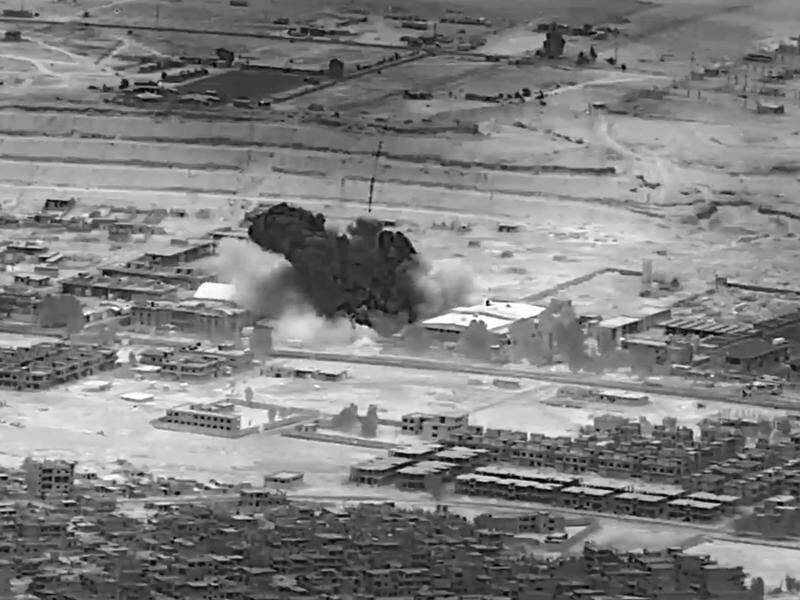
The United States military has conducted extensive airstrikes against multiple Islamic State positions in Syria. This operation, which took place on Friday, is a direct response to an attack that resulted in the deaths of U.S. personnel earlier in the week. The strikes targeted locations across central Syria, marking a significant escalation in military efforts against the group.
President Donald Trump had pledged to retaliate following the attack on U.S. forces, which occurred on Saturday in the town of Palmyra. A U.S. official, who spoke on the condition of anonymity, characterized the operation as a large-scale response to the incident. In total, the attack claimed the lives of two U.S. Army soldiers and a civilian interpreter, while three additional soldiers sustained injuries.
The attack in Palmyra involved an assailant who targeted a convoy of American and Syrian forces before being neutralized by return fire, according to the U.S. military. This incident underscores the ongoing risks faced by U.S. personnel stationed in the region.
Continuing Operations Against Islamic State
The recent airstrikes are part of a broader campaign by a U.S.-led coalition that has intensified over recent months. This coalition has been actively conducting airstrikes and ground operations to eliminate Islamic State targets, often in collaboration with Syrian security forces. The coalition’s efforts aim to dismantle the group’s remaining capabilities in the region.
In a separate but related situation, a global assessment released by the Integrated Food Security Phase Classification indicates that the humanitarian crisis in Gaza has reached a critical point. Following a fragile ceasefire on October 10, which ended hostilities between Israel and Hamas militants, there has been an improvement in access for humanitarian and commercial food deliveries.
The IPC report highlights that the dire conditions previously reported, which affected around 514,000 individuals in Gaza, have shifted. Although the organization states that there is no longer famine, it warns that the situation remains precarious and could deteriorate again under worst-case scenarios involving renewed conflict.
Aid and Access Challenges in Gaza
The Israeli military agency COGAT has asserted that about 600 to 800 trucks have entered Gaza daily since the ceasefire, with food supplies comprising roughly 70 percent of these deliveries. However, the IPC has criticized this assessment, arguing that it relies on insufficient data and does not accurately reflect the full scope of humanitarian assistance.
Israel’s Foreign Ministry has countered claims regarding the severity of the humanitarian situation, stating that food prices in Gaza have decreased significantly since July. Nonetheless, Hamas has contested these figures, claiming that the actual number of aid trucks entering Gaza is far lower than reported.
Aid organizations have consistently emphasized the need for increased humanitarian assistance in the densely populated enclave. They assert that many essential items remain blocked from entering, a claim that Israel firmly denies.
The IPC’s report underlines the critical thresholds that define famine conditions, which include extreme food shortages affecting at least 20 percent of the population, high rates of acute malnutrition among children, and significant mortality rates due to starvation or malnutrition-related diseases.
As the U.S. military intensifies its operations against the Islamic State, the humanitarian situation in Gaza remains a complex and urgent challenge, requiring sustained international attention and intervention.