



































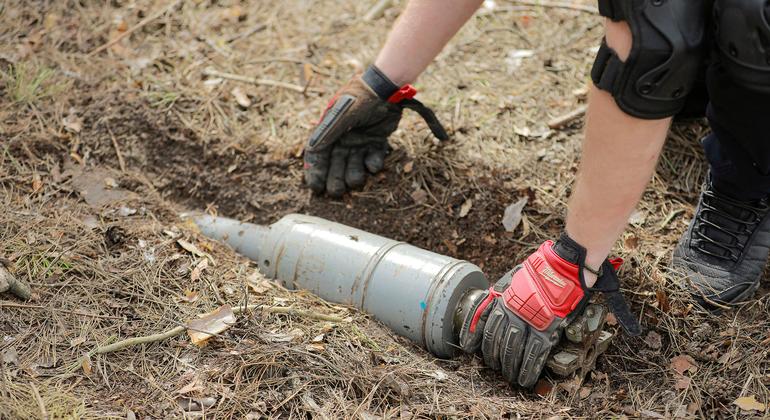
The United Nations has raised an alarm over the rising number of landmine casualties worldwide, particularly affecting civilians in conflict zones such as Afghanistan, Sudan, and Gaza. This urgent appeal for funding comes amid severe budget cuts that threaten crucial mine action programs responsible for saving lives.
At a key international meeting held in Geneva, experts highlighted the dire consequences of dwindling resources in regions like Afghanistan and Nigeria, where civilians face increasing risks from unexploded ordnance. The UN emphasized that mine action should be recognized as an immediate humanitarian necessity rather than a long-term recovery effort.
Afghanistan: A Child’s Tragic Reality
In Afghanistan, the toll of landmines is particularly devastating. The latest report from the Landmine Monitor reveals that a staggering 77 percent of all landmine casualties in the country last year were children. An average of 54 fatalities per month underscores Afghanistan’s position as the third highest in the world for explosive ordnance-related deaths.
Nick Pond, who leads mine action efforts at the UN Assistance Mission in Afghanistan (UNAMA), explained the grim reality for many children: “It tends to be kids, mostly boys in the hills tending sheep and goats… they are picking up things of interest and playing with them.” Despite the pressing need for more deminers, funding shortages have drastically reduced the workforce from 15,000 in 2011 to around 1,300 today.
Christelle Loupforest, the UNMAS Representative in Geneva, emphasized the importance of addressing the situation in Afghanistan, stating that the country has recorded a total of 30,154 child casualties since 1999. Without renewed support, mine clearance programs in Afghanistan, along with initiatives in Nigeria and Ethiopia, face imminent suspension.
Sudan and Nigeria: Escalating Dangers
The security situation in Sudan poses another serious challenge. As approximately 1.5 million civilians return to the capital, Khartoum, they are met with an urgent need for mine clearance. Sediq Rashid, the UNMAS chief in Sudan, indicated that just five clearance teams are currently operational in the city, highlighting that “all of them are in Khartoum,” where the need is most acute.
Rashid noted that previous shelling has left behind unexploded ordnance, posing grave risks to returning residents. He remarked that even essential infrastructure, like the runway of Khartoum’s main airport, has been cleared to facilitate humanitarian efforts.
In Nigeria, the situation is equally alarming. Edwin Faigmane, UNMAS chief in Nigeria, reported that displaced communities are at significant risk as they return to areas contaminated by explosive remnants. An alarming 80 percent of all civilian casualties occur in just 11 of the 15 regions designated for return. In response to this crisis, UNMAS has trained local security forces in risk education, a strategy that has begun to yield positive results.
Gaza and the West Bank: Humanitarian Efforts Compromised
In Gaza, the consequences of two years of intense conflict have resulted in a vast contamination of unexploded ordnance. Julius Van Der Walt, UNMAS chief in Gaza, described the situation as “absolutely immense,” stating that it directly threatens the safety of 2.1 million residents. The ongoing hazards impede humanitarian aid and reconstruction efforts, leaving civilians vulnerable while they attempt to collect necessities in areas known to harbor explosive remnants.
In the West Bank, the risks are increasing as densely populated areas become polluted with unexploded ordnance. Van Der Walt noted that “communities are being forced to live side by side with deadly remnants of war,” exacerbating the humanitarian crisis.
The UN Secretary-General’s campaign on mine action, launched on June 16, 2025, aims to uphold norms of humanitarian disarmament and accelerate mine action efforts. This initiative seeks to protect civilians, particularly children, who accounted for 46 percent of landmine casualties in 2024.
As the international community grapples with funding challenges, the UN calls for renewed support to enhance mine action programs, emphasizing their critical role in ensuring the safety and recovery of vulnerable populations in conflict-affected areas worldwide.
