




























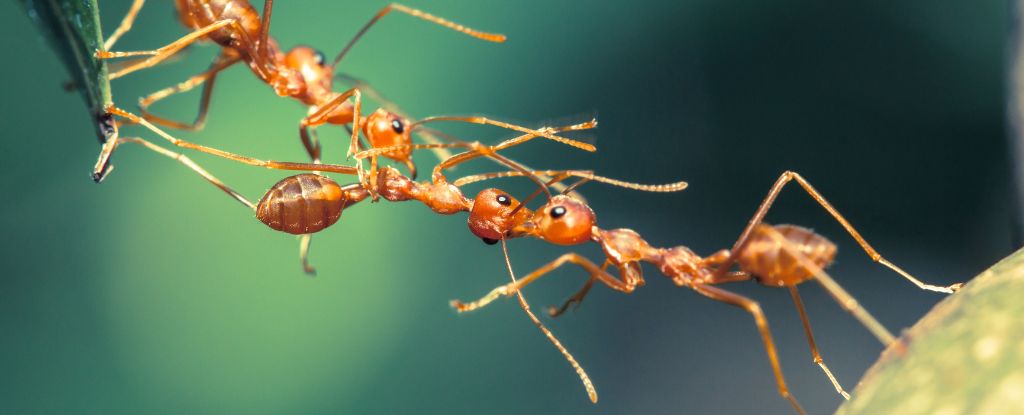
Recent research has revealed that weaver ants, known scientifically as Oecophylla smaragdina, exhibit a remarkable form of teamwork that defies conventional understanding of group dynamics. In a study published in Current Biology, scientists discovered that these ants not only overcome the inefficiencies often associated with larger groups but actually become more effective as their numbers increase.
The phenomenon known as the Ringelmann effect suggests that as teams grow, individual contributions tend to diminish. This effect, first identified by French engineer Max Ringelmann in the late 19th century, has been observed in various species, including humans. Ringelmann’s experiments showed that when students pulled on a rope together, their collective effort increased, but the average force exerted by each individual decreased with larger group sizes.
In contrast, the study led by Chris R. Reid from Macquarie University and Daniele Carlesso from the Max Planck Institute of Animal Behavior focused on the cooperative behavior of weaver ants. These ants are adept at constructing nests using living leaves, a process that requires them to form long chains and pull together. The researchers aimed to investigate whether these chains experienced the same decline in efficiency noted in other species.
The team conducted experiments where they encouraged the ants to form chains and pull an artificial leaf attached to a force meter that measured their collective pulling force. Surprisingly, the results showed that both the total force exerted by the ants and the force per individual increased as more ants joined the pulling effort. This finding indicates that weaver ants not only avoid the pitfalls associated with larger groups but achieve a level of efficiency that researchers have termed “superefficient.”
Exploring the Mechanics of Ant Cooperation
The researchers noted that the success of weaver ants hinges on their unique arrangement and division of labor within the chains. When forming a single, long chain, the ants displayed optimal performance. Notably, the positioning of the ants within the chain influenced their postures and roles. Rear ants adopted a stretched position to resist counter-forces, while those at the front maintained a crouched posture for active pulling.
This behavior led to the development of a concept termed the “force ratchet.” In this mechanism, the rear ants enhance their grip on the ground, which mitigates slippage and allows the front ants to exert greater force. The study proposes that this division of labor effectively locks in the force generated by the group, preventing any decline in overall output.
Future research is necessary to further confirm the force ratchet hypothesis, including experiments that manipulate variables such as surface slipperiness and the weight of the objects being pulled.
Implications for Robotics and Beyond
The findings from this study have significant implications, particularly in the realm of autonomous robotics. Current swarm robotics designs often exhibit linear scaling, where doubling the number of robots results in a proportional increase in force output. While this indicates that these robotic teams do not experience the Ringelmann effect, they also lack the superefficiency demonstrated by weaver ants.
By integrating strategies inspired by weaver ants, such as the force ratchet mechanism, researchers may enhance the performance of robotic teams, enabling them to achieve outcomes that surpass the simple sum of their individual contributions.
This research not only challenges the prevailing assumptions surrounding group dynamics but also highlights the exceptional capabilities of weaver ants. As the study concludes, when it comes to teamwork, sometimes having more really is better, illustrating the extraordinary potential of collective action in the animal kingdom.