



































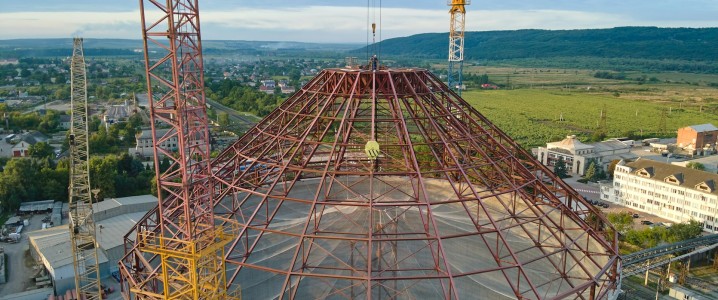
China is poised to commence commercial operations of the world’s first small modular reactor (SMR) as early as the first half of 2026. This significant development was announced by Wang Zhenqing, president of the China Institute of Nuclear Industry Strategy. The reactor, named Linglong One, is located in Hainan Province and holds the distinction of being the first SMR approved by the International Atomic Energy Agency (IAEA) back in 2016.
The China National Nuclear Corporation (CNNC) reported in October that Linglong One has successfully completed its primary circuit cold functional test earlier this year. This milestone marks a critical step towards its operational readiness. CNNC emphasized that Linglong One is the first commercial onshore small modular reactor worldwide to pass the IAEA safety review, highlighting a major advancement in China’s independent nuclear innovation.
Advantages of Small Modular Reactors
According to Wang Zhenqing, China intends to utilize Linglong One and other small reactors primarily to cater to power demands in regions with less robust electrical grids. The design of SMRs offers several advantages; they are simpler and more economical to construct and install. Their smaller footprint allows for placement in locations unsuitable for larger reactors. Furthermore, SMRs can be built incrementally, aligning with the escalating energy requirements of specific sites.
While China moves ahead with the commercial launch of its first SMR, the United States lags behind, with operational small modular reactors still several years away. This timing underscores an increasing emphasis on nuclear innovation, particularly as nations seek sustainable and efficient energy solutions.
Innovations in Nuclear Technology
In addition to the advancements related to Linglong One, China recently made headlines with a groundbreaking development in nuclear reactor materials and technology. Scientists from the Shanghai Institute of Applied Physics at the Chinese Academy of Sciences announced a world-first achievement: the conversion of thorium into uranium within a thorium molten salt reactor. This advancement could potentially lead to safer fission energy with reduced waste and the elimination of water use for cooling.
The progress in both the SMR project and thorium reactor technology signifies China’s commitment to enhancing its nuclear capabilities and addressing global energy challenges. With Linglong One set to lead the charge in SMR technology, the implications for energy production could be profound, affecting not only domestic power supplies but also the global nuclear energy landscape.