






























Recent research published in Current Biology has revealed that weaver ants, known scientifically as Oecophylla smaragdina, exhibit a remarkable ability to work together effectively, defying a well-known phenomenon known as the Ringelmann effect. This effect suggests that as group size increases, the individual contribution often diminishes. Contrary to this trend, the study found that the efficiency of weaver ants actually improves with larger group sizes.
The Ringelmann effect, identified by the French engineer Max Ringelmann in the late 19th century, highlights how collaboration can sometimes lead to decreased effort per person. In his experiments, Ringelmann observed that when students pulled on a rope together, the total force increased, but the average effort per individual decreased. This phenomenon is attributed to coordination difficulties in larger groups and a tendency for individuals to exert less effort when part of a collective.
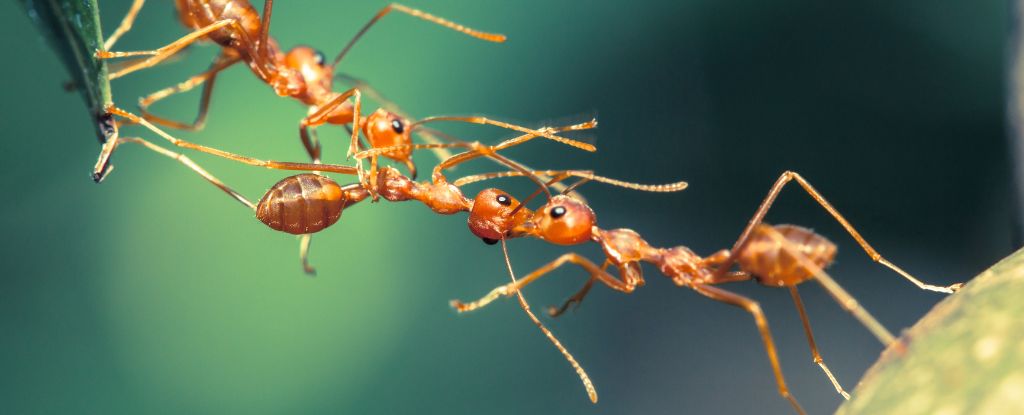
In this new study, researchers sought to determine whether weaver ants also fell victim to this effect. Weaver ants are distinguished for their ability to construct nests in treetops by pulling living leaves together and binding them with silk produced by their larvae. To assess their teamwork, scientists conducted experiments where groups of weaver ants were encouraged to form pulling chains to manipulate an artificial leaf attached to a force meter.
As the experiment progressed, researchers noted that while the total force increased as more ants participated, the force exerted by each ant also increased. This finding was surprising, as prior studies on other ant species, such as fire ants, showed that larger groups demonstrated the Ringelmann effect, with individual contributions diminishing as size increased.
Chris R. Reid, a researcher at Macquarie University, and Daniele Carlesso, a postdoctoral fellow at the Max Planck Institute of Animal Behavior, led the study. They proposed that the weaver ants’ success stems not merely from the number of ants involved but from their specific arrangements during the task. The ants were most effective when organized into a single, elongated chain, which allowed them to optimize their pulling strategy.
The research identified a mechanism termed the “force ratchet,” where the weakest link in the pulling chain is not the ants’ connections to each other but rather their grip on the ground. When pulling independently, an ant’s force output is limited by slippage. However, in a chain formation, the rear ants can stabilize the group, enabling front ants to exert greater force. This unique division of labor enhances overall efficiency, allowing the ants to work together more effectively.
The implications of this research extend beyond the realm of biology. The findings could inform advancements in the field of autonomous robotics, where teams of small robots are designed to collaborate on complex tasks. Currently, most robotic teams exhibit linear scaling, meaning that if the number of robots doubles, the force output doubles as well. By incorporating principles observed in weaver ants, such as the force ratchet mechanism, robotic systems may achieve greater efficiencies and operate more effectively as cohesive units.
This study challenges the prevailing notion of the Ringelmann effect and suggests that, in certain instances, larger teams can be more effective. As the researchers concluded, for weaver ants, more truly is better. Their teamwork exemplifies how complex organisms can develop strategies to overcome common collaborative pitfalls, potentially offering valuable insights for both natural and artificial systems.