














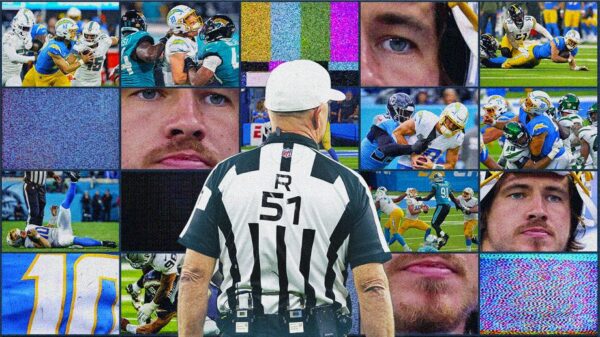











In a heated moment during the second quarter of the Week 11 game against the Pittsburgh Steelers, both Los Angeles Chargers coach Jim Harbaugh and quarterback Justin Herbert expressed their frustration over officiating. After outside linebacker Alex Highsmith made contact below Herbert’s knees shortly after a pass, Herbert, visibly upset, gestured angrily at the nearest official. Harbaugh, not far away on the sidelines, mirrored this sentiment as the Steelers pressured Herbert 12 times and sacked him five times in the Chargers’ 25-10 victory.
Herbert’s emotional response marked a departure from his typically composed demeanor. Throughout the season, he has faced significant pressure, with 149 hits and 196 pressures, both leading the league according to ESPN Research and NFL Next Gen Stats. This level of contact raises questions about whether Herbert should advocate more for himself during games.
Interestingly, Harbaugh has suggested that Herbert’s calm approach might be contributing to his lack of calls from officials. While other quarterbacks may argue for penalties, Herbert has preferred to maintain a polite demeanor, which Harbaugh believes may lead to him being overlooked. “I [complain] more than Justin does,” Harbaugh remarked last season, highlighting the disparity in how quarterbacks are treated based on their demeanor and physicality.
Despite his relatively restrained approach, statistics indicate that Herbert has received two accepted roughing the passer penalties this season, tying him for second in the league. In contrast, Dak Prescott leads with four penalties. Since entering the league in 2020, Herbert’s total of eight roughing penalties places him fifth overall, behind Prescott, Kirk Cousins, Josh Allen, and Jared Goff.
A significant question arises: does arguing effectively influence officiating? Many quarterbacks believe that while immediate results may be negligible, advocating for themselves could lead to more favorable calls in the future. Herbert himself stated, “Arguing isn’t going to get me anywhere. If I make a big deal out of it, odds are they’re not going to call it.”
Former NFL quarterbacks Matt Ryan and Josh McCown, along with current players like Tua Tagovailoa and Matthew Stafford, emphasize the need for a strategic approach when interacting with officials. Ryan, who has the most accepted roughing penalties since 2000, noted, “You don’t want to be the guy who cried wolf.”
In a separate incident during the Rams’ Week 5 game against the San Francisco 49ers, Stafford reacted strongly to a hit that could have warranted a penalty. He sprinted towards the official, visibly frustrated, yet received little acknowledgment. Stafford, who shares the same total of accepted roughing penalties as Herbert, commented on the importance of making officials aware of potential infractions.
Quarterbacks often face accusations of exaggerating their reactions to draw flags. In a notable instance, Tagovailoa faced criticism from Chargers players after a hit led to a roughing penalty against defensive tackle Teair Tart. Tagovailoa defended his actions, stating, “If I feel like I get the ball out and then there’s a couple seconds in between where I’m getting hit, then I’ll be like, ‘Dude,’ and I look back to the ref.”
Despite leading the league in accepted roughing penalties this season, Prescott admitted that he struggles to find the best way to engage with officials. “I usually get fired up, mad that he didn’t give me the call, and their response isn’t usually pleasant either,” he reflected.
Criticism of officiating regarding Herbert intensified last season after he was sacked multiple times against the Cleveland Browns. Harbaugh publicly questioned whether Herbert was receiving fair treatment, likening him to NBA legend Shaquille O’Neal in terms of size and the tendency to overlook big players for penalties.
In the following weeks, Herbert continued to face significant hits, including a controversial call against BJ Green II of the Jacksonville Jaguars, which drew national scrutiny. “How do you want them to play?” questioned former outside linebacker J.J. Watt regarding the hit.
The ongoing conversation surrounding quarterback treatment raises important questions about the relationship between officials and players. As Herbert prepares to face the Philadelphia Eagles on “Monday Night Football,” he remains focused on the game. “I’ve let the refs know when I thought there was a late hit,” he said, acknowledging the complexities of officiating.
While Herbert’s recent outburst may have been an anomaly, his performance against the Eagles could determine whether he continues to advocate for himself on the field. The balance between maintaining credibility with officials and ensuring player safety remains a critical issue in the NFL.