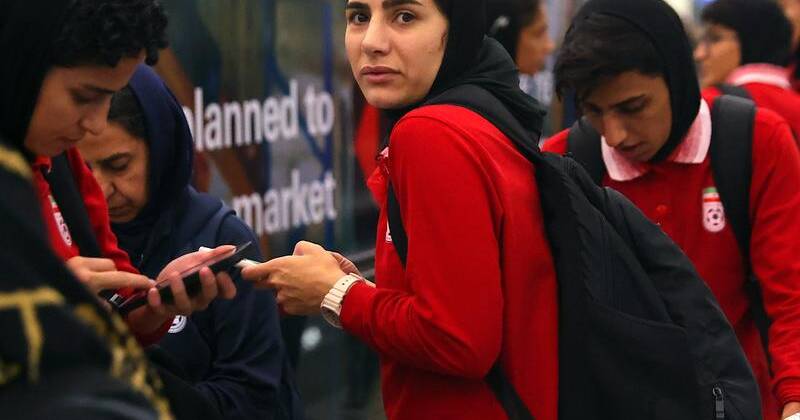
The captain of the Iranian women’s soccer team, Zahra Ghanbari, has decided to withdraw her asylum claim and return to Iran, citing threats against her family from the Iranian regime. This decision follows the departures of several team members who previously accepted offers to remain in Australia after the Women’s Asian Cup. According to the Iranian Society of Queensland, the Iranian government has targeted the families of players still in Australia, raising fears for their safety upon returning home.
Ghanbari’s withdrawal marks her as the fifth player to reverse her initial decision. The state-run news agency IRNA celebrated the return of all but two players, framing it as a victory for the embattled regime. A vice-president of the Iranian Society of Queensland, Hadi Karimi, claimed that threats were communicated to players through a staff member who had been granted asylum. He stated, “One of the players had communicated her family had been kidnapped.” He emphasized the severity of the situation, calling for awareness about the implications of the Iranian Islamic Revolutionary Guard Corps (IRGC)‘s influence in Australia.
Several players faced intense pressure from the Iranian Football Federation and the IRGC, according to former Iranian soccer player and current activist Shiva Amini. She indicated that systematic intimidation had been directed towards the families of the players, particularly targeting Ghanbari, whose father recently passed away. “This shows the level of cruelty and desperation they are willing to use to force these athletes to comply,” Amini wrote on the social media platform X.
Amini described how players were persuaded to return through a manager who posed as a trustworthy figure. This manipulation, combined with persistent threats against their families, led to overwhelming fear among the athletes. Home Affairs Minister Tony Burke noted that despite the government’s best efforts to protect the players, three members of the team had chosen to leave. Seven members of the Iranian soccer group, including six players and one support staff member, had initially been granted humanitarian visas to stay in Australia.
The Australian government acknowledged the difficult choices faced by the players. Cabinet minister Catherine King stated, “They would have been facing enormous pressure from what was happening overseas, in their home country as well.”
The team departed from their Gold Coast hotel on March 5, 2024, under police escort. Reports indicated that one player was forcibly assisted onto the bus by a teammate, illustrating the distress surrounding their departure.
Concerns are mounting regarding the safety of the returning athletes, especially after they faced public backlash in Iran for refusing to sing the national anthem before their opening match. State media labeled them “wartime traitors,” further complicating their situation as tensions in the Middle East escalate amid ongoing conflicts involving the US, Israel, and various Gulf countries.
The situation for the Iranian women’s soccer team underscores the complex intersection of sports, politics, and personal safety, highlighting the challenges faced by athletes under oppressive regimes. As the players navigate their return to Iran, the international community watches closely, aware of the potential repercussions of their choices.