



































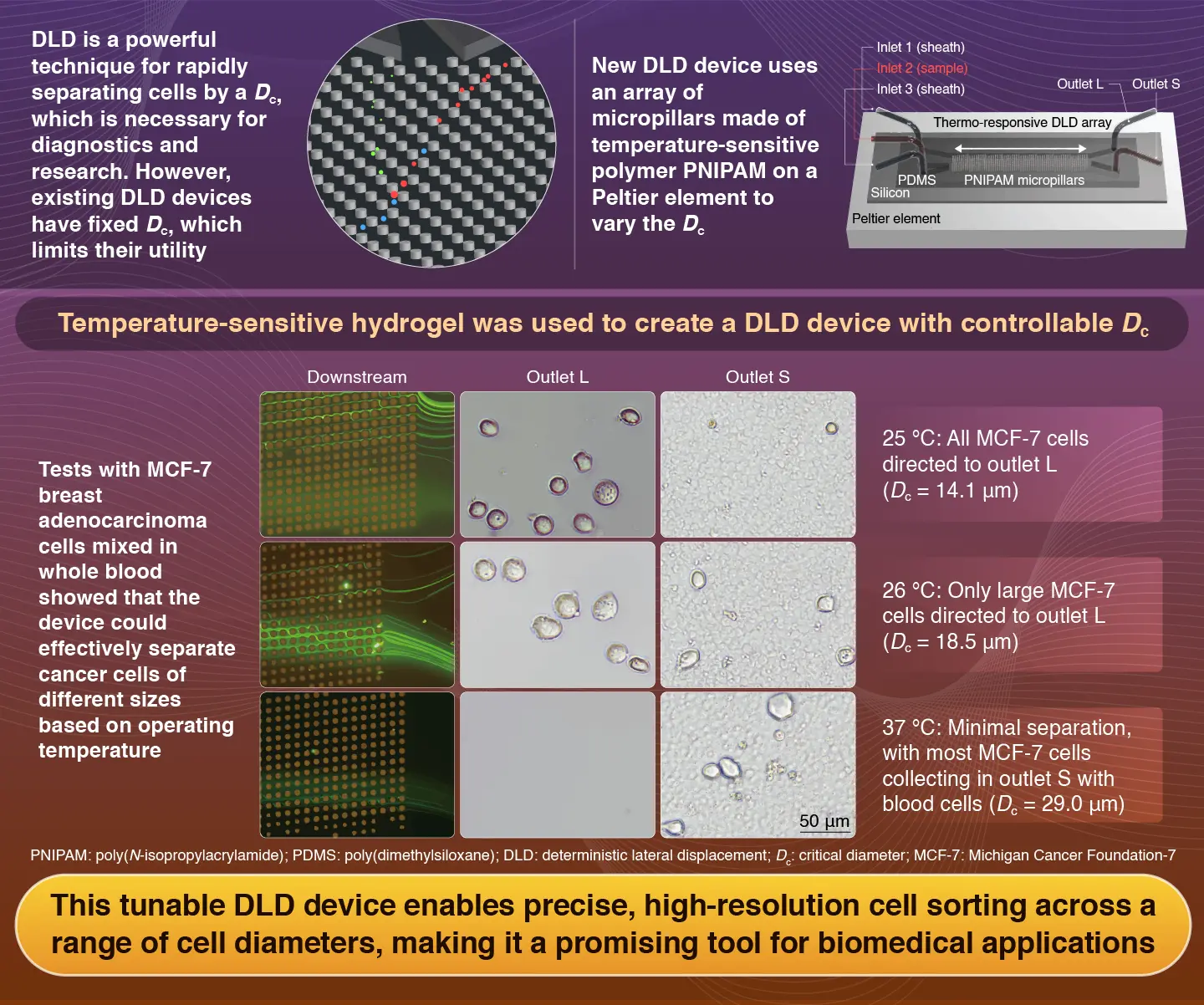
Researchers at the Institute of Science Tokyo have developed a novel tunable cell-sorting device that shows promise for biomedical applications, particularly in cancer detection. The new technology, which utilizes poly(N-isopropylacrylamide) (PNIPAM) hydrogel, can selectively sort cancer cells from blood samples based on size by adjusting the temperature. This breakthrough was detailed in a study published on September 3, 2025, in the journal Lab on a Chip.
Advancements in Cell Sorting Technology
The ability to isolate specific cell types is vital for many medical diagnostics, including the identification of metastatic cancer cells in the bloodstream. Traditional size-based cell sorting methods, such as deterministic lateral displacement (DLD), have gained popularity due to their efficiency and ability to maintain the metabolic activity of isolated cells. However, conventional DLD devices can only operate effectively at a single critical diameter (D c) for sorting, which limits their versatility and can lead to blockages.
The team, led by Associate Professor Takasi Nisisako and Assistant Professor Yusuke Kanno, along with graduate student Ze Jiang, sought to overcome these limitations by creating a tunable DLD platform. The innovative design employs PNIPAM micropillars that expand and contract in size when subjected to temperatures ranging from 20 to 40 °C. This feature allows the device to adjust the critical diameter dynamically, enabling it to sort cells of varying sizes efficiently.
Nisisako explained, “Our previous work demonstrated a thermo-responsive DLD array on a glass substrate. The PNIPAM-based approach simplifies the fabrication process and allows for direct temperature-driven modulation of pillar dimensions.”
Successful Testing with Cancer Cells
The latest iteration of the DLD device integrates a silicon base on a Peltier element, enhancing thermal control and operational stability. The design includes PDMS microchannels that transport the liquid sample to the PNIPAM microarray, with two outlets for sorted cells. This setup allows for precise manipulation of the sorting process.
In testing, the researchers used blood samples spiked with Michigan Cancer Foundation-7 (MCF-7) breast adenocarcinoma cells, which have an average diameter of 17 μm. At an initial temperature of 25 °C, with a critical diameter of 14.1 μm, the device achieved a sorting efficiency of 90%, successfully directing MCF-7 cells to one outlet. As temperatures increased to 26 °C and 37 °C, the device continued to sort cells effectively, showcasing its tunability.
Nisisako expressed optimism about the potential applications of their device, stating, “The precision, versatility, and reliability of this platform underscore its potential for high-resolution size-based sorting, making it a promising tool for a wide range of biomedical applications.” Looking ahead, the research team aims to validate the device’s effectiveness using actual patient samples, which could significantly enhance cancer diagnostics and treatment monitoring.
The advancements presented by this tunable DLD device represent a significant step forward in biomedical technology, potentially transforming how healthcare professionals detect and manage cancer through more efficient cell sorting methods.