


































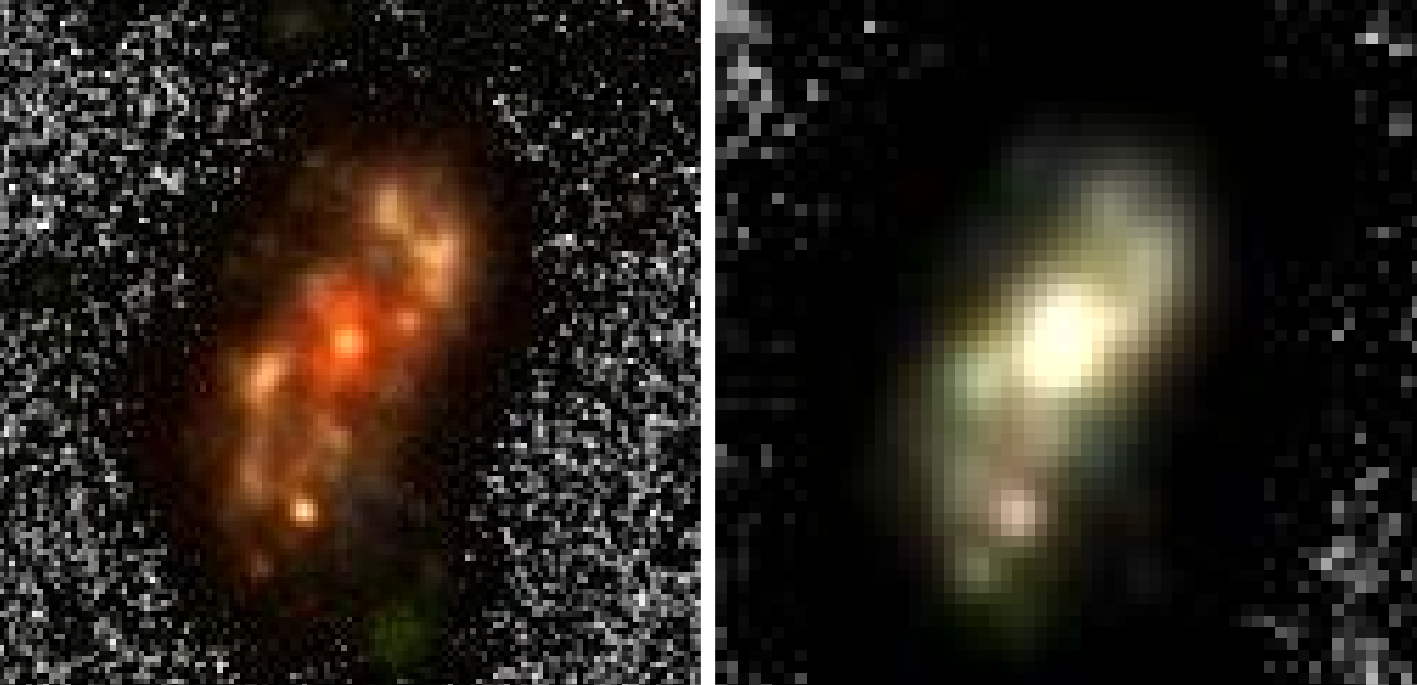
Researchers have identified a large, well-structured spiral galaxy named Alaknanda, located approximately 12 billion light-years from Earth. This discovery, made using observations from NASA’s James Webb Space Telescope, reveals the galaxy’s formation occurred soon after the Big Bang, when the universe was only about 1.5 billion years old. The findings have been published in the journal Astronomy & Astrophysics.
The discovery of Alaknanda challenges previous theories about galaxy formation in the early universe. For decades, astronomers believed that galaxies formed in a chaotic environment, resulting in irregular shapes rather than orderly spirals. Observations from the Hubble Space Telescope supported this view, as spiral galaxies seemed scarce beyond 11 billion years in look-back time.
Yogesh Wadadekar, co-author of the study, noted, “Alaknanda reveals that the early universe was capable of far more rapid galaxy assembly than we anticipated.” He emphasized that this galaxy managed to gather 10 billion solar masses of stars into a spiral structure within just a few hundred million years, a remarkably swift process in cosmic terms.
Significance of the Discovery
The James Webb Space Telescope has significantly advanced our understanding of galaxies from the early universe. It has revealed many disk-shaped galaxies, including a growing number of true spiral galaxies, much earlier than previous models predicted. Other notable discoveries include the spiral galaxies CEERS-2112 and REBELS-25, found in 2023 and 2024, respectively.
Alaknanda, named after a river in the Himalayas, spans approximately 32,000 light-years and contains a substantial number of stars. The galaxy exhibits a flat, rotating disk with two distinct spiral arms, characterized by their smooth and symmetrical appearance. This structure has earned Alaknanda the designation of a “grand-design” spiral galaxy, indicating well-defined arms rather than fragmented ones.
The researchers observed bright clumps of newborn stars along the spiral arms, which resemble a string of beads. These clusters indicate areas where gas has collapsed into dense pockets, igniting new star formation. Observing Alaknanda across various wavelengths of light allowed scientists to estimate the age of its stellar population, finding that the stars average only about 200 million years old.
Future Research Directions
To further understand Alaknanda’s history, researchers compared its brightness across 21 different wavelengths, ranging from ultraviolet to infrared. This analysis revealed that approximately half of its stars formed in a rapid burst after the universe had already reached 1 billion years in age. The galaxy’s rapid star formation rate stands at about 63 suns per year, substantially outpacing the Milky Way’s current rate.
Certain wavelengths emitted from Alaknanda appear brighter than expected, indicating intense star-forming activity fueled by glowing gas surrounding new stars. Despite these advances, scientists remain uncertain about the mechanisms behind the rapid formation of spiral arms in ancient galaxies. Some theories propose that these structures arise from slow-moving density patterns in the disks, while others suggest gravitational disturbances caused by nearby galaxies or large gas clumps.
Alaknanda also appears to have a small neighboring galaxy, which may have influenced its spiral structure. More evidence is needed to confirm this hypothesis. Future observations utilizing Webb’s instruments for measuring stellar and gas motions, as well as radio telescopes, could provide insight into how Alaknanda’s stars and gas orbit its center. This research may help clarify whether its disk has settled into a final configuration or if the spiral arms represent an intermediate phase in its development.
The discovery of Alaknanda marks a pivotal moment in our understanding of galaxy formation, suggesting that the processes contributing to the development of complex structures occurred much earlier than previously thought.