































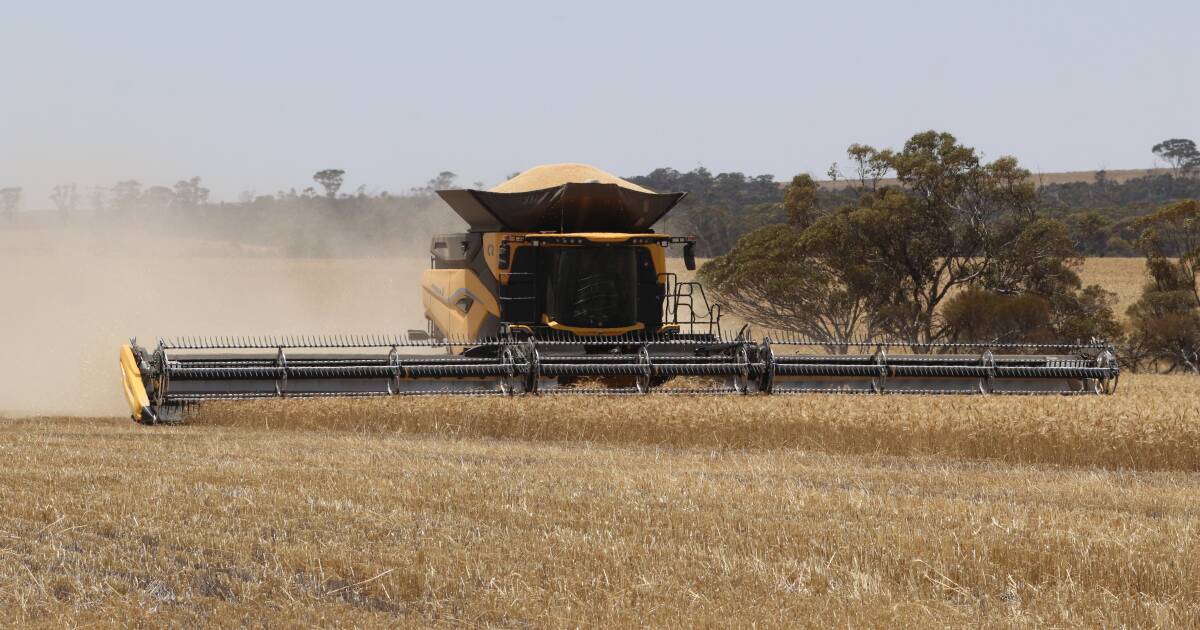
Broadacre graingrowers in Australia are experiencing a significant shift in harvesting efficiency thanks to the demonstration of the New Holland CR11 header. On a recent Friday afternoon, sales representatives from McIntosh & Son showcased this advanced machinery by harvesting a 100-hectare community wheat crop in Wyalkatchem.
Campbell Jones, a grain producer from the area, is among the local growers who volunteer their time each year to help with seeding, spraying, and harvesting. “I just help out when I can; Will Nightingale does a fair bit, and Nutrien Ag Solutions handles the agronomy work,” said Jones. This year, the chosen wheat variety was Vixen, yielding an impressive two tonnes per hectare, though slightly less than last year’s yield of 2.6t/ha. Jones noted that the growing season was challenging, with only about 190 millilitres of rainfall recorded.
The proceeds from the community crop are designated for local sports clubs, contributing to improvements such as new greens at the bowling club and renovations at the golf club.
Advancements in Harvesting Technology
At the helm of the CR11, Kyle Finlay, a sales representative from the Cunderdin branch of McIntosh & Son, highlighted the machine’s enhanced capabilities. Equipped with a MacDon FD2 60-foot front, the CR11 represents a complete redesign rather than mere upgrades. Key features include a C16 Cursor engine producing 775 horsepower and a 20,000-litre grain tank, which boasts an impressive unload rate of 210 litres per second.
The CR11 combines dual rotary technology with a redesigned processor, making it particularly advantageous for large-scale grain operations in Western Australia. “It’s an absolute beast,” Finlay remarked. “It’s performing well, and obviously, it’s a great new product to have out on the market.” He noted that with the FieldOps system activated, the machine is capable of harvesting up to 75 tonnes per hour, a significant increase compared to the estimated 45t/hr of its predecessors, the CR9 and CR10 models.
Finlay also mentioned the CR11’s ability to maintain a ground speed of approximately 9 kilometres per hour, facilitating quicker harvesting processes. The machine’s capacity to spread residue a full 60 feet behind the front allows for better agronomic management and reduces the need for secondary passes over the field. “We’ve got tighter crops per paddock in Cunderdin; there’s too many rocks and trees, so you can’t just run a 60-footer through there,” he explained.
Impact on Local Agriculture
Anthony Ryan, general manager of northern branches at McIntosh & Son, emphasized the importance of the CR11’s first demonstration season. “Our teams are in the field at every startup, assisting with configurations, completing harvest loss tests, and ensuring our customers get the best out of the machine,” Ryan stated. He highlighted that the combination of capacity, sample quality, residue management, and in-cab automation is proving transformative for local farmers.
As the harvest progresses in Cunderdin, Finlay observed a remarkably positive turnaround from earlier projections. “From what it looked like in June, it didn’t seem like there’d be much of a harvest at all,” he said. “It just goes to show that things can turn around, and now we’re looking at a record harvest.” He noted that similar conditions last year resulted in good crops despite late rainfall.
The New Holland CR11 header is setting a new standard for broadacre graingrowers, showcasing how technological advancements can enhance productivity and efficiency in agriculture. As local producers adapt to these innovations, they are poised to achieve greater harvest outcomes and contribute to the economic vitality of their communities.