



































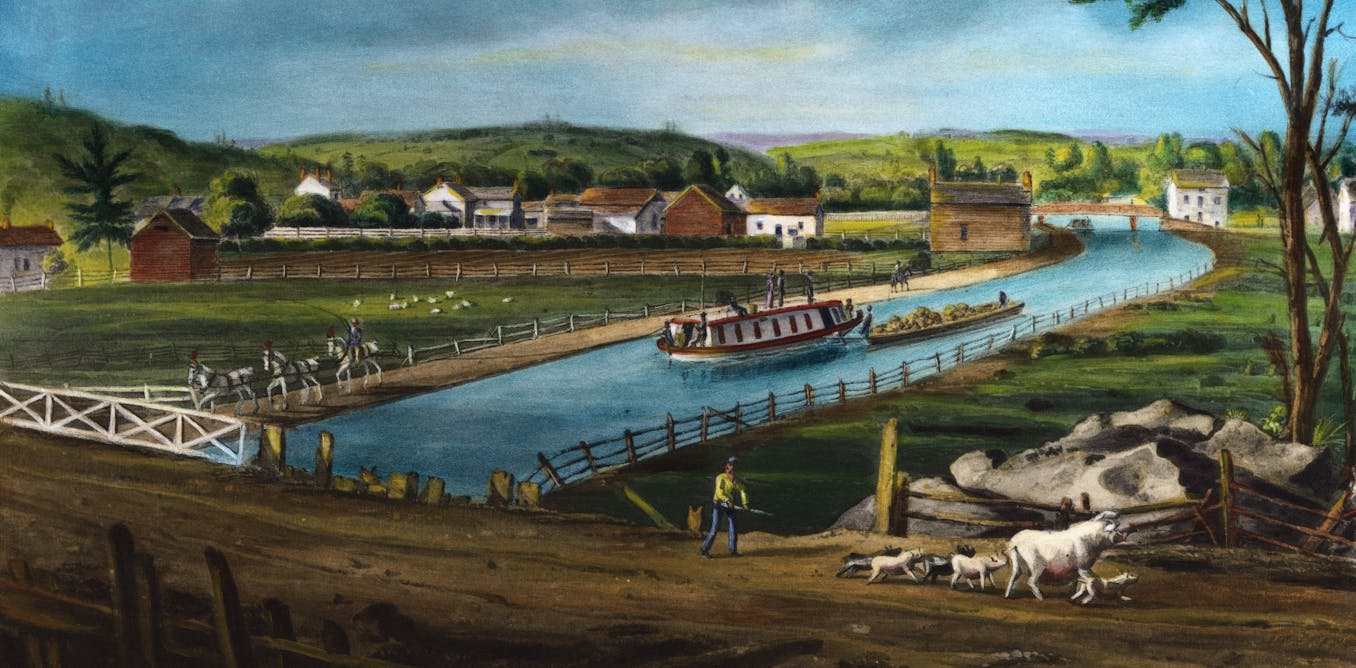
The Erie Canal marked its 200th anniversary on October 26, 2025, commemorating the opening of a pivotal waterway that transformed trade and the environment in the United States. Initially designed to connect the Great Lakes to the Atlantic Ocean, the canal has profoundly influenced New York’s economic landscape while leaving a lasting ecological impact.
Today, the canal features a peaceful waterway frequented by hikers, cyclists, and kayakers. Yet, its origins in the early 19th century were not about leisure or scenic beauty. When the canal opened, it cut through over 360 miles of forests and fields, leaving behind a landscape marked by deforestation and rapid industrialization. Mules could pull barges at speeds of up to 4 miles per hour, significantly faster than the horse-drawn wagon transport of the time. This efficiency resulted in an astounding 90% reduction in freight costs, facilitating the movement of goods and people between the Midwest and New York City.
Economic Boom and Ecological Consequences
The completion of the Erie Canal in 1825 bolstered New York’s reputation as the Empire State. It became a critical trade artery, making the port of New York the nation’s financial hub. However, the canal’s construction also came at a significant ecological cost. Environmental historians underscore the complex legacies of the canal, illustrating the challenges of balancing economic progress with ecological preservation.
The canal’s construction, advocated by New York politician DeWitt Clinton, faced skepticism and financial hurdles. Critics derisively referred to the canal as “Clinton’s Folly,” yet with state funding, thousands of laborers began work in 1817. The project led to innovations, such as hydraulic cement and advanced lock systems, but it also destroyed vast areas of wetlands and forests, disrupting local ecosystems.
The impact on Indigenous communities was particularly profound. The construction of the canal was made possible by the dispossession of the Haudenosaunee Confederacy, the Indigenous nations formerly known as the Iroquois. Trade routes and traditional practices were severely disrupted, marking a significant loss of cultural and ecological heritage.
Invasive Species and Long-Term Environmental Impact
The Erie Canal inadvertently facilitated the introduction of invasive species to the Great Lakes, altering the delicate balance of local ecosystems. Following the canal’s opening, species such as the Atlantic sea lamprey and alewife entered the lakes, preying on native fish populations and leading to a dramatic decline in commercial fisheries. By the early 1960s, lake trout harvests had plummeted by an alarming 98%.
The canal also enabled the passage of zebra mussels, which arrived in the Great Lakes during the 1980s via the St. Lawrence Seaway. These invasive mussels caused significant ecological disruption, leading to a near tenfold reduction in phytoplankton, the foundational food source for many aquatic species in the Hudson River ecosystem. The presence of zebra mussels has resulted in the disappearance of two native pearly mussel species due to competition for resources, habitat degradation, and pollution.
Efforts to control invasive species in the Great Lakes are costly and ongoing, requiring approximately $20 million annually for effective management. The canal remains susceptible to further invasions, emphasizing the need for continued vigilance from recreational users to prevent the spread of nonnative organisms.
As the Erie Canal enters its third century, its history reflects the ongoing struggle to reconcile human activity with ecological integrity. The creation of Adirondack Park in 1892, established to protect waterways from erosion and siltation, highlights the growing awareness of environmental issues during the Gilded Age.
Today, while commercial shipping has declined due to competition from the St. Lawrence Seaway and other transport methods, the Erie Canalway National Heritage Corridor has emerged as an economic driver. In 2024, approximately 3.84 million people engaged in recreational activities along the canal, contributing over $300 million to the local economy.
The bicentennial of the Erie Canal serves as a timely reminder of the intricate relationship between technological advancement and environmental stewardship. As New York reimagines the future of this crucial waterway, understanding its environmental history will be vital for designing systems that support both human communities and natural ecosystems.