































Asian stock markets closed mostly higher on March 15, 2024, despite a downturn in technology shares on Wall Street. Investors reacted positively to the performance of gold and silver, which saw significant rebounds after recent declines. US futures also showed an upward trend, with the S&P 500 increasing by 0.2 percent and the Dow Jones Industrial Average rising by 0.3 percent.
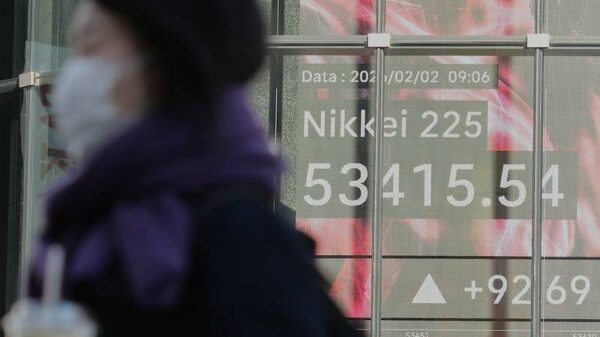
The Tokyo Stock Exchange’s Nikkei index fell 0.8 percent, retreating from a record high reached just the day before. Major players in Japan’s tech sector faced losses, with shares of chipmaker Tokyo Electron and testing equipment manufacturer Advantest both dropping by 2.1 percent. The SoftBank Group saw a decline of 2.2 percent, while Nintendo experienced a sharp drop of 11 percent. This drop occurred despite the company reporting strong profits, as concerns lingered over the sustainability of sales for the recently launched Switch 2 game console.
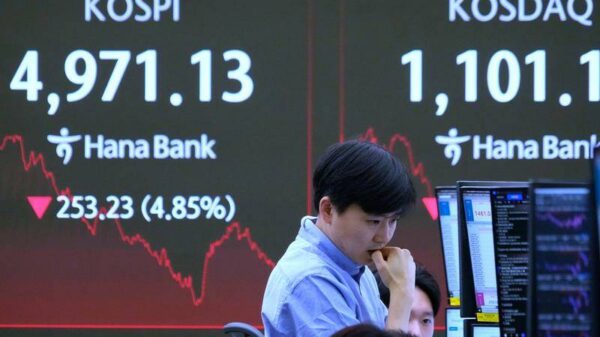
In contrast, South Korea’s Kospi index rose by 1.6 percent to close at 5,371.10, with Samsung Electronics gaining nearly 1 percent. The index has been on a near-daily record-setting streak. Meanwhile, Hong Kong’s Hang Seng index edged up by 0.1 percent, and the Shanghai Composite index climbed by 0.9 percent. China’s blue-chip CSI300 Index also posted gains, rising by 0.8 percent. Australia’s S&P/ASX 200 closed with a gain of 0.8 percent, while Taiwan’s Taiex rose by 0.3 percent, although India’s Sensex slipped by 0.1 percent.
Gold and silver regained traction on Wednesday, with gold rising by 3.3 percent and silver jumping by 7.3 percent. This recovery is attributed to a shift in investor sentiment towards safe-haven assets amid ongoing geopolitical tensions, a weakening US dollar, and uncertainties surrounding tariffs. Analysts from ING Bank, including Warren Patterson and Ewa Manthey, noted that “after plunging from record highs amid elevated volatility, precious metals attracted renewed buying interest.” They also emphasized that safe-haven demand is expected to support gold prices in the medium term.
On the previous day, the S&P 500 dropped by 0.8 percent to close at 6,917.81, while the Dow Jones Industrial Average fell by 0.3 percent to 49,240.99. The Nasdaq composite saw a more significant decline of 1.4 percent, ending at 23,255.19. Major technology firms faced scrutiny, with Nvidia falling by 2.8 percent and Microsoft dropping by 2.9 percent. Concerns regarding the overvaluation of technology stocks and the viability of substantial investments in artificial intelligence have led to fluctuations in the sector.
In other sectors, PayPal suffered a substantial loss of 20.3 percent following disappointing quarterly results. Pharmaceutical giant Pfizer dipped by 3.3 percent, despite reporting stronger-than-expected quarterly profits.
Oil prices also saw an uptick, with US benchmark crude gaining 36 cents to reach $63.57 per barrel. Brent crude, the international standard, rose by 25 cents to $67.58 per barrel. Analysts attributed the increase partly to renewed tensions between the US and Iran, following an incident where a US Navy fighter jet downed an Iranian drone near a US aircraft carrier.
The US dollar strengthened against the Japanese yen, rising to 156.46 yen from 155.77. The euro traded at $1.1830, up from $1.1818.
As the global markets continue to navigate economic uncertainties, investors remain vigilant about shifts in technology, commodities, and geopolitical landscapes.