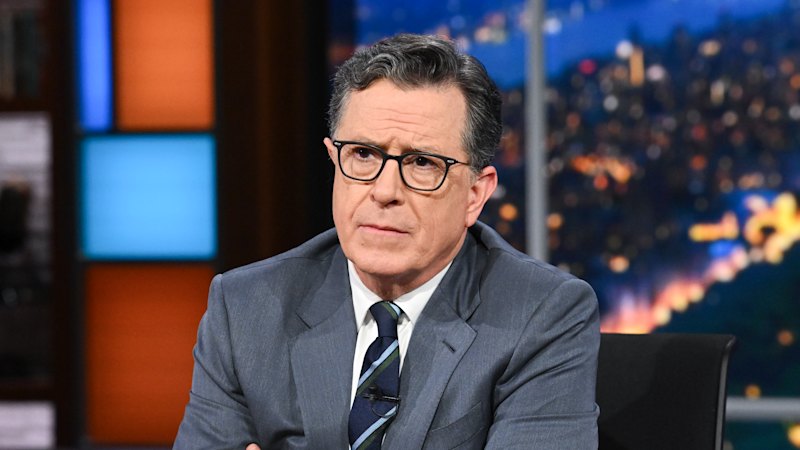
Late-night host Stephen Colbert announced that his interview with Democratic Senate candidate James Talarico was removed from the broadcast schedule due to concerns over compliance with the Trump administration’s political neutrality guidelines. This revelation came just hours before early voting commenced in Texas for primary elections that feature several competitive Senate nomination races.
During an episode of his show, The Late Show with Stephen Colbert, on March 4, 2024, Colbert stated, “He was supposed to be here, but we were told in no uncertain terms by our network’s lawyers, who called us directly, that we could not have him on the broadcast.” He further elaborated that he was instructed not to mention the interview’s cancellation, highlighting the network’s apparent reluctance to address the situation publicly.
Talarico, who is in a heated contest for the Democratic nomination, responded by sharing a clip of the interview on X, referring to it as “the interview Donald Trump didn’t want you to see.” He also expressed his belief that the cancellation is a manifestation of a “dangerous kind of cancel culture,” suggesting that it stems from the upper echelons of power.
Broadcast Regulations and Network Response
Broadcast networks have historically been required to provide equal airtime to political candidates. However, this rule has not typically applied to late-night talk shows. In January 2024, the Federal Communications Commission (FCC) issued new guidelines cautioning hosts of both late-night and daytime shows that they must adhere to equal time requirements, with FCC Chairman Brendan Carr questioning the traditional exemption given to talk shows.
Colbert noted that while the equal time provision applies to traditional broadcasting, it does not extend to streaming platforms. His interview with Talarico, which lasted nearly 15 minutes, was ultimately shared on the show’s YouTube channel, with Colbert clarifying that it was not part of the broadcast.
In response to the controversy, CBS denied that Colbert was explicitly banned from airing the interview, claiming that legal guidance advised against broadcasting it to avoid triggering the FCC’s equal time rule. The network stated that The Late Show opted to present the interview online instead of risking potential complications.
Political Context and the Race Ahead
Talarico is competing in a closely watched primary against Jasmine Crockett, a U.S. Representative, with both candidates aiming to secure the Democratic nomination for the Senate. A recent poll from the University of Houston indicated that Crockett leads by eight percentage points. Nonetheless, Talarico has a significant fundraising advantage, with his campaign and allied groups having spent approximately $14.1 million on advertisements, compared to only $2.2 million for Crockett.
As the political landscape in Texas evolves, Talarico’s campaign is focused on attracting independents and disenchanted Republicans, while Crockett emphasizes mobilizing the party base and non-voters. The dynamics of this race, particularly in the context of recent federal guidance on political neutrality, will likely continue to attract scrutiny as the primary approaches.
Colbert, known for his critical stance towards Trump, faces his own challenges, as CBS announced in July 2023 that it would not renew his show for another season, with his current contract set to expire in May 2026. This decision, coming shortly after Colbert’s comments on a settlement involving Trump and CBS’s parent company, Paramount Global, raised questions among U.S. senators regarding the motivations behind the cancellation.
As late-night television navigates these complex political waters, the intersection of broadcasting regulations and media freedom remains a contentious topic, particularly as candidates like Talarico seek to engage voters in an increasingly polarized environment.