



































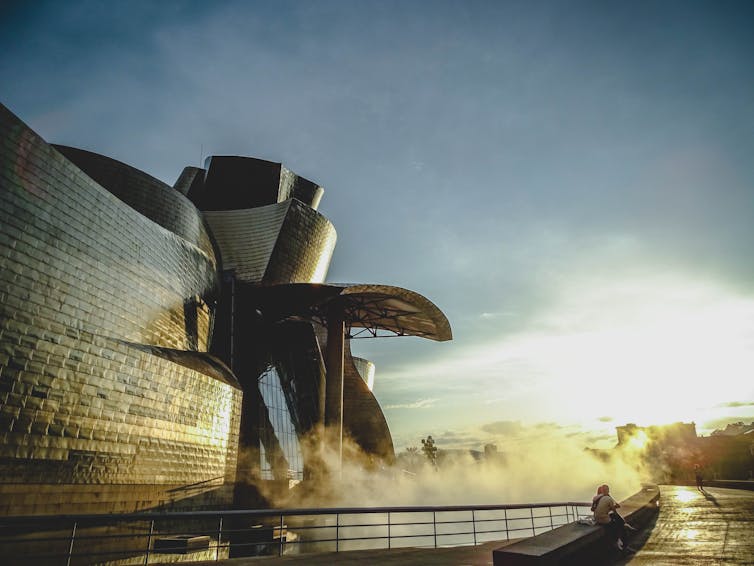
Renowned architect Frank Gehry has passed away at the age of 96, leaving behind a legacy marked by boundary-pushing designs and cultural impact. Known for his unconventional approach, Gehry’s work transformed urban landscapes and inspired cities worldwide to embrace architecture as a catalyst for cultural renewal.
Gehry was born Frank Owen Goldberg in Toronto, Canada, in 1929. He moved to Los Angeles in the late 1940s and later adopted the name Gehry. His architectural career began with a commercial practice established in 1962, but it was not until the late 1970s that he gained recognition for his distinctive style, which combined elements of deconstruction and whimsy.
In the early 1990s, Gehry’s design for the Guggenheim Museum in Bilbao, Spain, marked a pivotal moment in his career. Commissioned to create a striking arts center to revitalize the city, Gehry delivered a 57-meter-high structure characterized by swirling forms of titanium and glass. Completed in 1997, the museum’s success led to what is now known as the “Bilbao effect,” a phenomenon where cities use iconic architecture to boost their cultural and economic standing.
The impact of Gehry’s work extended far beyond Bilbao. His designs included the Walt Disney Concert Hall in Los Angeles, completed in 2003, and the Museum of Pop Culture in Seattle, a vivid structure resembling a shattered electric guitar. His only Australian building, the Dr Chau Chak Wing Building, located in Sydney and finished in 2014, was inspired by a crumpled paper bag, showcasing his playful exploration of form.
Gehry’s distinctive approach often sparked debate. He was featured in the influential 1988 Museum of Modern Art exhibition on deconstructivist architecture, which highlighted his unconventional designs alongside those of other notable architects. His work was celebrated for its unique aesthetic, yet it was his ability to engage with the public’s perception of architecture that truly set him apart.
Over his career, Gehry received numerous accolades, including the prestigious Pritzker Prize in 1989. The jury recognized his “controversial but always arresting body of work,” noting that his designs were “iconoclastic, rambunctious, and impermanent.” Interestingly, many of Gehry’s most significant contributions came after he received this honor, demonstrating his relentless creativity and innovation.
Despite his success, Gehry maintained a sense of humility and introspection about his work. He once expressed mixed feelings about appearing on an episode of The Simpsons, where he portrayed himself. While the appearance brought him mainstream recognition, he felt it oversimplified the complexities of his architectural process.
Gehry’s designs have left an indelible mark on cities around the world, influencing cultural discourse and urban revitalization efforts. His home in Santa Monica, California, remains a testament to his enduring legacy, a work in progress that reflects his artistic journey.
As the architectural community reflects on Gehry’s contributions, it is clear that his visionary approach will continue to inspire future generations of architects and city planners. His commitment to challenging conventions has reshaped the architectural landscape and left an enduring impact on cultural identity.
