

































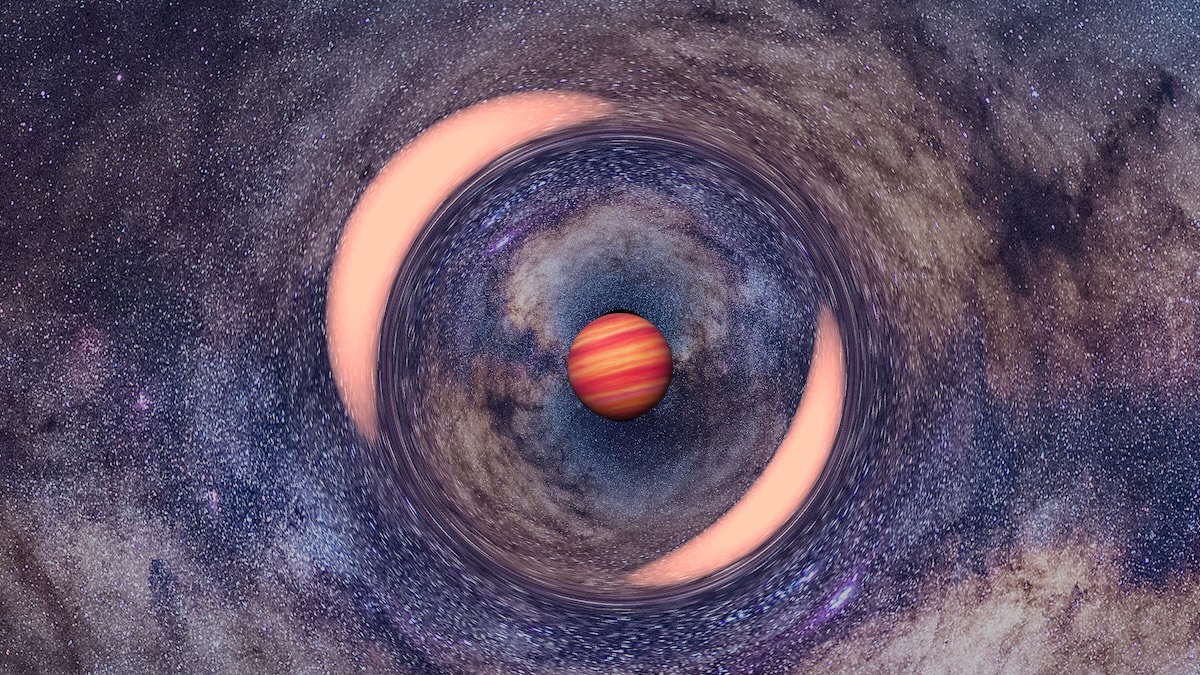
Astronomers have achieved a significant milestone by measuring the mass and distance of a rogue planet that orbits the galaxy alone, without a star. This planet, which possesses approximately 22 percent of the mass of Jupiter, is situated nearly 9,785 light-years from Earth, towards the center of the Milky Way. This groundbreaking discovery sheds light on the characteristics and formation of these elusive celestial bodies.
Rogue planets, which are not bound to any star, are often challenging to detect due to their small size and dimness. Traditionally, astronomers identify these planets through their gravitational effects on the light from distant stars. When a rogue planet passes in front of a bright background object, its gravitational field acts as a lens, distorting the light in a phenomenon known as gravitational microlensing.
Astronomers faced a unique challenge in determining the mass of this particular rogue planet, as its solitary orbit provides minimal context for distance calculations. Fortunately, a rare opportunity arose during a microlensing event observed on May 3, 2024. Multiple ground-based telescopes located in Chile, South Africa, and Australia independently recorded the event. Additionally, the now-retired Gaia Space Telescope captured six observations over a span of 16 hours.
The distinct advantage of the Gaia’s positioning—1.5 million kilometers from Earth—allowed it to view the microlensing event from a different angle than ground-based telescopes. This variation in perspective enabled astronomers to estimate the distance to the lensing object. The process parallels how human beings perceive depth using slightly offset inputs from both eyes.
Through this method, researchers calculated that the rogue planet is located about 9,785 light-years from Earth. The findings were detailed in a study published in the journal Science.
Astrophysicist Gavin Coleman from Queen Mary University of London highlighted the importance of this technique for future studies, particularly with the anticipated launch of the Nancy Grace Roman Space Telescope in 2027. Coleman noted, “This finding demonstrates how coordinated observations can overcome difficulties in determining both the position and mass of a rogue planet and improve the understanding of how these planets form.”
The Roman Space Telescope is expected to survey vast areas of the sky at a speed 1,000 times faster than the Hubble Telescope, significantly enhancing the chances of capturing additional gravitational lensing events.
This achievement marks a pivotal moment in the study of rogue planets, expanding our understanding of these solitary worlds and their formation processes. As technology advances, astronomers are poised to uncover even more mysteries of the cosmos.