



































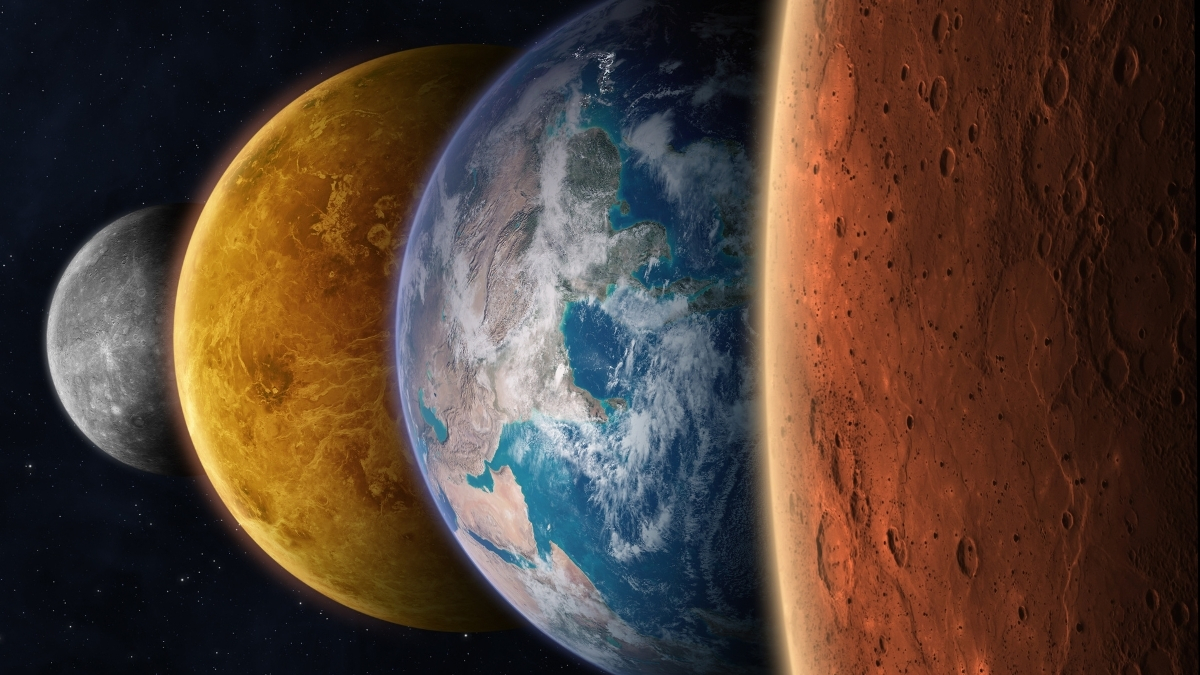
Recent research has uncovered that Mars significantly influences Earth’s climate, challenging previous understandings of how planetary interactions shape our environment. This study, led by Stephen Kane and his team, highlights the gravitational effects of Mars on Earth’s climatic variations through detailed computer simulations.
The research builds on the established concept of Milankovitch cycles, which are variations in Earth’s orbit and axial tilt that influence climate over millions of years. While it has long been accepted that Jupiter and Venus play critical roles in these cycles, the new findings suggest that Mars, despite its smaller size, is a major contributor to Earth’s climatic rhythms.
Significant Findings from Computer Simulations
Kane’s team conducted simulations that altered Mars’s mass from zero to ten times its current weight, analyzing the impact on Earth’s orbital patterns. Their results indicated that Mars is essential in defining not only the longer cycles but also the shorter intervals that govern ice age transitions.
The most stable cycle identified was the 405,000-year eccentricity cycle, primarily driven by interactions between Jupiter and Venus. This cycle remains unaffected by changes in Mars’s mass, providing a consistent framework for understanding Earth’s climatic shifts. However, the simulations revealed that the shorter, approximately 100,000-year cycles are highly sensitive to Mars’s gravitational influence. As Mars’s mass increases, these cycles become more pronounced, indicating stronger interactions among the inner planets.
One of the most intriguing findings is that when Mars’s mass approaches zero, a critical climate pattern disappears entirely. The 2.4 million-year “grand cycle”, responsible for long-term climate fluctuations, relies on Mars’s gravitational pull to create the necessary resonance. This cycle affects the amount of sunlight Earth receives over extended periods, directly impacting climate.
Implications for Climate Understanding and Exoplanet Habitability
Mars’s influence extends beyond Earth’s climate dynamics. The research indicates that variations in Earth’s axial tilt, or obliquity, are also affected by Mars. The familiar 41,000-year obliquity cycle lengthens as Mars’s mass increases. In scenarios where Mars is ten times its current mass, this cycle shifts to a range of 45,000 to 55,000 years, significantly altering ice sheet growth and retreat patterns.
These insights are not only relevant for understanding Earth’s climate history but also carry implications for assessing the habitability of exoplanets. A terrestrial planet with a massive neighboring planet in a favorable orbital configuration may experience climate variations that help maintain stable conditions conducive to life, preventing extreme freezing or enabling more favorable seasonal cycles.
Kane’s research emphasizes that Earth’s Milankovitch cycles are the result of interactions within our entire planetary neighborhood, with Mars playing an unexpectedly pivotal role. This work has been made available on ArXiv and originally published by Universe Today, reflecting a significant advancement in our understanding of planetary climate dynamics.