



































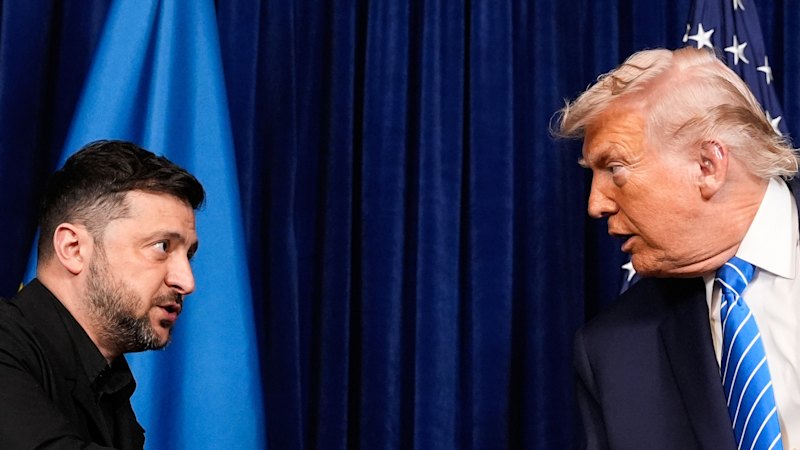
Ukrainian President Volodymyr Zelensky has called for a long-term security guarantee from the United States, proposing a commitment lasting up to 50 years to deter potential future invasions by Russia. In an audio message to reporters, Zelensky expressed his desire for a more extended guarantee than the current proposal under discussion, which suggests a term of 15 years with options for extensions. “We would like to consider the possibility of 30, 40, or even 50 years,” he stated, emphasizing that such a guarantee would mark a historic decision by Donald Trump.
As part of a broader peace plan, Zelensky indicated that confirmed US security guarantees would enhance protection for Ukraine, supplemented by commitments from nations within the so-called Coalition of the Willing. He noted that European Union membership would also play a crucial role in these security arrangements. Zelensky mentioned, “Monitoring the ceasefire — our partners will provide it, technical monitoring and presence. All these details will be in the security guarantees.”
The comments followed a meeting between Zelensky and Trump at the US president’s Mar-a-Lago resort in Florida on December 10, 2023. While both leaders acknowledged that significant progress was made toward a potential deal to end the ongoing conflict, they also recognized that key issues remained unresolved. Among these were the status of territories in eastern Ukraine and the future of the Zaporizhzhia Nuclear Power Plant, currently under Russian control.
Zelensky reported that no consensus was reached regarding Russian President Vladimir Putin’s demands, specifically concerning Ukraine’s withdrawal from the Donbas region, which is partially occupied by Russian forces. Uncertainty also persists over US proposals aimed at establishing a demilitarized or free economic zone in eastern Ukraine, including questions about territorial control.
Trump expressed optimism about the negotiations, stating that a deal was “getting a lot closer,” but acknowledged that finalizing an agreement could take several weeks. Zelensky remarked that the peace plan is “90 percent agreed,” reflecting a significant step forward in discussions. Following their talks, Trump held what he described as “very productive” conversations with Putin.
Looking ahead, Zelensky mentioned that Ukraine aims to convene with European partners and Trump in January 2024, followed by a separate meeting with Russian officials. The Coalition of the Willing is scheduled to meet at the beginning of January to discuss ongoing support for Ukraine, as confirmed by French President Emmanuel Macron.
Despite nearly a year of US diplomatic efforts failing to yield a conclusive agreement, Trump indicated that he would only engage with Ukrainian and Russian leaders again if an agreement appeared imminent. Negotiations have primarily involved Trump envoys, including Steve Witkoff and Jared Kushner.
Zelensky stated that Ukraine “does not care” about the format of negotiations with Russia. He emphasized the necessity for Putin to show genuine willingness to negotiate by halting attacks on Ukraine. “These actions do not coincide with the peaceful vocabulary that he uses in dialogue with the US president,” Zelensky remarked.
The ongoing conflict remains Europe’s deadliest since World War II, with Ukrainian officials working to revise a 28-point draft plan initially proposed by the US, which was perceived as overly favorable to Russia. The latest iteration comprises 20 points; however, Moscow has indicated it cannot accept certain elements, including stipulations regarding the size of Ukraine’s post-war military.
Russia is also demanding guarantees against NATO’s eastward expansion and clarity on Ukraine’s neutral status should it join the EU. Furthermore, Moscow seeks assurances regarding the removal of sanctions and the status of hundreds of billions of dollars of Russian state assets frozen in the West.
As the situation continues to evolve, the international community awaits further developments on these critical negotiations, which hold significant implications for regional stability and security.
