



































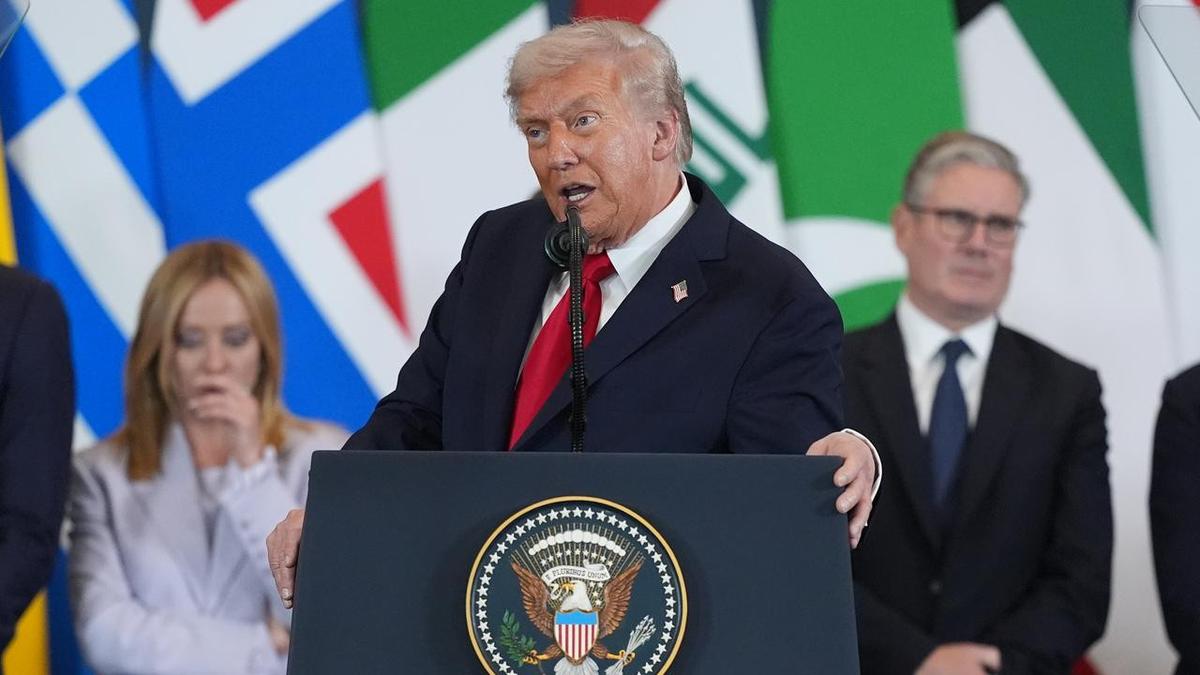
Governments around the world are responding cautiously to U.S. President Donald Trump’s invitation to join his new initiative, the Board of Peace, aimed at addressing global conflicts. This plan has raised concerns among diplomats who fear it could undermine the work of the United Nations. As of now, only Hungary, a close ally of Trump, has unequivocally accepted the invitation, which was sent to approximately 60 nations and began arriving in European capitals on March 15, 2024.
The Board of Peace is proposed to be chaired for life by Trump and would initially focus on the conflict in Gaza. According to a copy of the invitation letter and draft charter obtained by Reuters, member states would have three-year terms unless they contribute $1 billion each to secure permanent membership. The White House justified this arrangement, stating, “This simply offers permanent membership to partner countries who demonstrate deep commitment to peace, security, and prosperity.”
During a visit to South Korea, Italian Prime Minister Giorgia Meloni expressed her country’s willingness to contribute, although it was unclear if her comments pertained specifically to Gaza or the broader peace initiative. Meanwhile, Canadian Prime Minister Mark Carney indicated his agreement in principle to the Board of Peace for Gaza, though details remain under discussion.
The United Nations Security Council had authorized a mandate for a Board of Peace in November 2023, but this was limited to the Gaza conflict and valid only through 2027. Notably, both Russia and China, key veto-wielding members, abstained from this resolution, expressing concerns that it did not clearly define the UN’s role in the future of Gaza.
Concerns about the initiative’s potential to weaken UN efforts were amplified by the inclusion of a charter in the invitation letter. Diplomats from several European nations have voiced fears that this could create a “Trump United Nations,” diverging from the principles enshrined in the UN charter. One diplomat remarked, “It looks as if it would undermine the United Nations if it went ahead.”
The invitation list includes leaders from France, Germany, Italy, Hungary, Australia, Canada, the European Commission, and key Middle Eastern powers. Hungarian Prime Minister Viktor Orban, in his acceptance via social media platform X, stated, “We have, of course, accepted this honourable invitation.”
The letter emphasizes the need for “pragmatic judgement, common-sense solutions, and the courage to depart from approaches and institutions that have too often failed.” It advocates for a “more nimble and effective international peace-building body,” which has elicited mixed reactions from the international community.
In response to inquiries regarding the draft charter for the Board of Peace, a spokesperson for UN Secretary-General Antonio Guterres stated that member states are free to associate in various groups. Deputy UN spokesperson Farhan Haq affirmed that the UN will continue its mandated work regardless of the developments surrounding the Board of Peace.
Trump has expressed a keen interest in the Nobel Peace Prize, indicating in his letter that the board will convene soon, describing it as “one of a kind; there has never been anything like it!” As the global community continues to digest this ambitious proposal, the implications for international diplomacy and the role of the UN remain to be seen.
