



































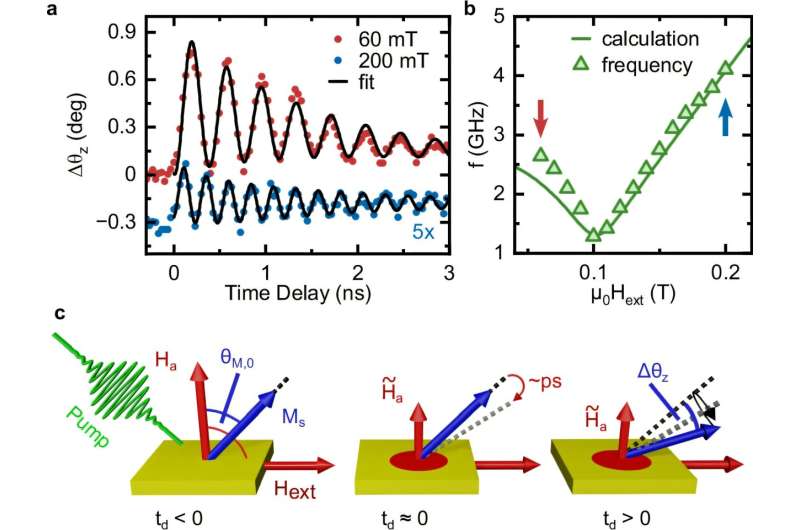
Physicist Davide Bossini from the University of Konstanz has achieved a significant breakthrough in the control of magnetic oscillations, demonstrating the ability to change the frequency of collective magnetic waves, known as magnons, by up to 40%. This advancement utilizes commercially available devices and operates at room temperature, making the technology more accessible for practical applications.
The study, published on January 14, 2026, in the journal Nature Communications, outlines how Bossini and his team manipulated the “magnetic DNA” of materials through the interaction of light and magnons. This interaction allows for instantaneous and on-demand control of oscillation frequencies using a weak magnetic field combined with intense laser pulses.
Methodology and Collaboration
Bossini’s research builds on years of study into the dynamics of light and magnetic materials. In the summer of 2025, he demonstrated a method to alter the magnetic characteristics of a material using light. The latest findings expand on this by showing that the frequency of magnetic oscillations can be adjusted by as much as 40% under specific conditions. The effect arises from the interplay between optical excitation, magnetic anisotropy, and external magnetic fields.
This research involved collaboration with scientists from the ETH Zurich, the RPTU University Kaiserslautern-Landau, and two Italian institutions: the Polytechnic University of Bari and the University of Messina. The study was rigorous, incorporating both theoretical and experimental approaches to validate the findings.
Implications for Data Technology
The ability to control the frequency of magnetic oscillations has significant implications for future data storage and transfer technologies. As a majority of digital data in the cloud is stored magnetically, this advancement could enhance the efficiency of data writing and retrieval processes. Bossini’s method highlights how spin waves could be utilized for these purposes, paving the way for innovations in data technology.
A crucial aspect of Bossini’s research is the use of readily available materials and equipment. “We don’t need a self-developed custom laser,” he notes, emphasizing the practicality of their approach. The experiments utilized a standard laser system and conventional permanent magnets, all conducted at room temperature. This contrasts sharply with the typical practice of studying magnetic materials at temperatures below 80 Kelvin (-193.15 degrees Celsius).
The material used in the experiments is only 20 nanometers thick, making it suitable for integration into computer chips. The sample materials were meticulously prepared by researchers at ETH Zurich, while the theoretical groundwork was established by partners at the Polytechnic University of Bari and the University of Messina.
Bossini’s work not only advances fundamental physics but also opens new avenues for applying these principles in practical technologies, underscoring the importance of interdisciplinary collaboration in scientific research.