





























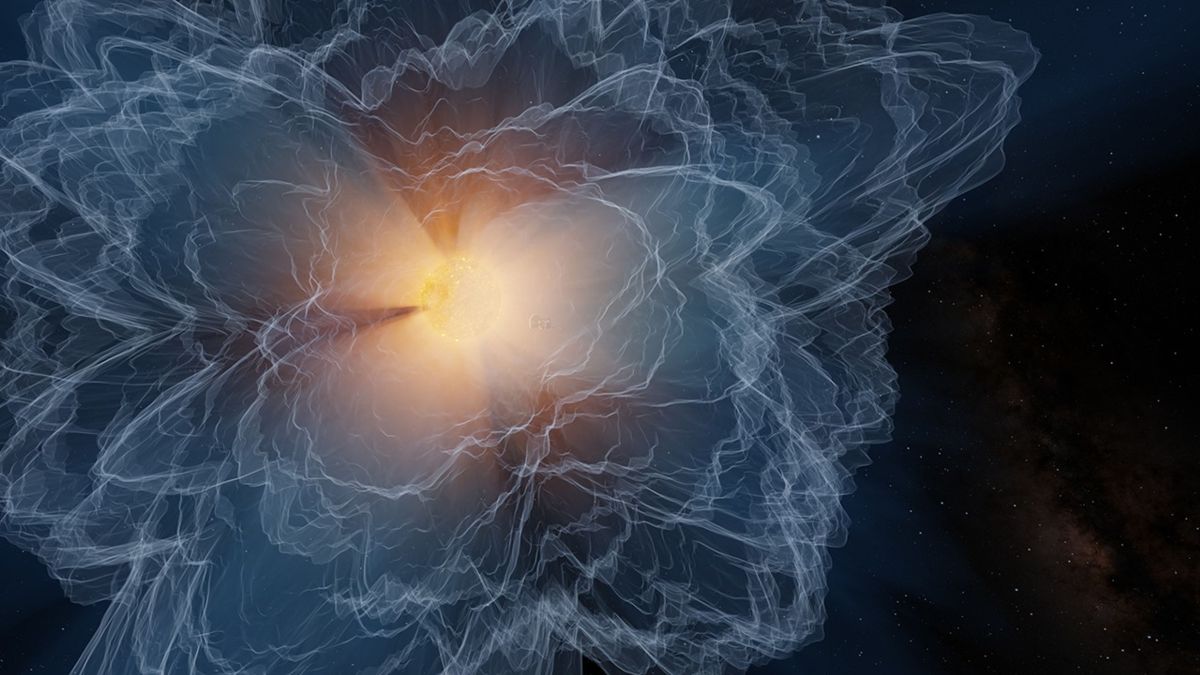
Scientists have unveiled the most detailed map of the boundary of the Sun, known as the Alfvén surface. This groundbreaking research, conducted using data from various spacecraft across the Solar System, provides insights into where the Sun’s magnetic influence ceases to accelerate the solar wind. This comprehensive mapping not only illustrates the shape of the Alfvén surface but also tracks its evolution during the first half of Solar Cycle 25, the current cycle characterized by fluctuating solar activity.
The Alfvén surface represents a critical threshold. As researchers explain, this boundary indicates the point at which solar material can no longer propagate back toward the Sun, marking a transition where the solar wind flows freely without magnetic guidance. Understanding this boundary is essential for comprehending the dynamics of the Sun’s atmosphere, which can have significant repercussions for space weather affecting Earth.
“Parker Solar Probe data from below the Alfvén surface could help answer big questions about the Sun’s corona, like why it’s so hot,” said Sam Badman, an astrophysicist at the Harvard & Smithsonian Center for Astrophysics (CfA) and the study’s lead author. “To answer those questions, we first need to know exactly where the boundary is.”
Mapping the Interface of Solar Wind
The solar wind, a continuous stream of charged particles emitted from the Sun, escapes from below the Alfvén surface. This boundary serves as an interface where the solar wind transitions from being magnetically guided to a freely streaming outflow. Variations in the shape and position of this boundary can significantly influence interactions with Earth and other planets, affecting communications technology and satellite operations.
The Parker Solar Probe is the only spacecraft equipped to measure the Alfvén surface directly. Since its launch, it has completed several perihelion encounters—daring dives into the solar atmosphere. The probe’s data, combined with observations from Solar Orbiter and three other spacecraft positioned at the L1 Lagrange point, has allowed researchers to gather comprehensive information about the solar wind’s speed, density, temperature, and magnetic field.
The findings indicate that during most perihelion encounters, the Parker Solar Probe skimmed the roiling Alfvén surface. However, during two significant dives taken at solar maximum, the probe ventured deep below this boundary. Over the course of six years, data revealed that the Alfvén surface expanded by approximately 30 percent of its median height as solar activity intensified.
Implications for Solar Science
As the Sun progresses through its activity cycles, researchers have observed that the shape and height of the Alfvén surface become larger and more irregular. “What we’re seeing is that the shape and height of the Alfvén surface are getting larger and spikier,” Badman noted. “That’s actually what we predicted in the past, but now we can confirm it directly.”
These insights not only enhance our understanding of solar phenomena but also carry implications for the study of other stars. For instance, more magnetically active stars are likely to possess larger Alfvén boundaries, which could affect the habitability of nearby planets.
Before this research, scientists relied on estimations of the Sun’s boundary from a distance, lacking direct methods to validate their findings. Now, with an accurate map of the Alfvén surface, researchers can observe changes in real time and correlate them with close-up data collected by the Parker Solar Probe.
“This work shows without a doubt that Parker Solar Probe is diving deep with every orbit into the region where the solar wind is born,” said Michael Stevens, an astronomer at CfA. “We are now headed for an exciting period where the probe will witness firsthand how those processes change as the Sun goes into the next phase of its activity cycle.”
The study’s findings have been published in The Astrophysical Journal Letters, marking a significant advancement in solar research and paving the way for future explorations into the dynamics of our Sun and beyond.