



































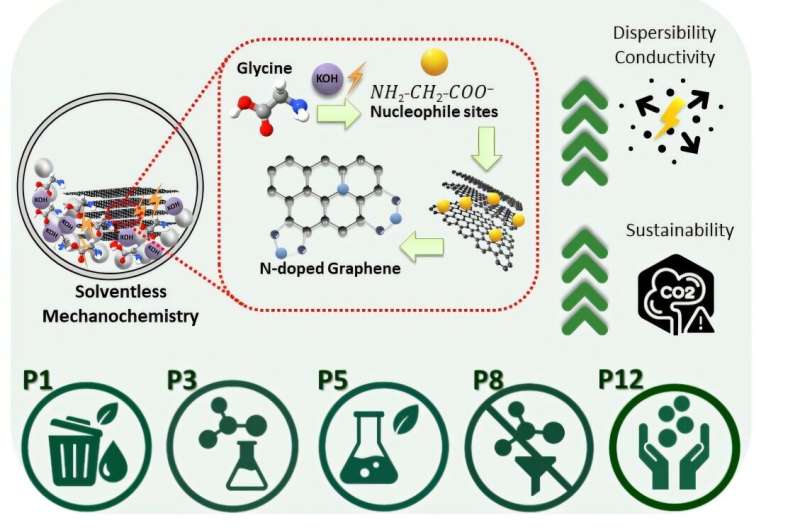
Research led by Chamalki Madhusha, a Ph.D. researcher at Monash University, has unveiled a sustainable method for producing nitrogen-doped graphene nanoplatelets (N-GNPs) that could revolutionize the material’s applications. Published on December 25, 2025, in the journal ACS Sustainable Chemistry & Engineering, this study addresses the environmental concerns associated with traditional graphene functionalization processes.
Graphene, often hailed as a “wonder material,” boasts exceptional strength, electrical conductivity, and thermal efficiency. Despite its remarkable properties, many graphene-based technologies have struggled to transition from laboratory settings to real-world applications. A significant hurdle has been the difficulty in dissolving graphene in common solvents. As a result, researchers have depended on harsh, multi-step functionalization processes that often produce considerable waste and environmental damage.
Madhusha’s research focuses on a pivotal question: Can advanced materials be designed without resorting to environmentally damaging methods? The study introduces a solvent-free, bio-derived mechanochemical approach to produce N-GNPs, potentially paving the way for more sustainable functionalized graphene materials.
Challenges in Graphene Functionalization
Pristine graphene possesses impressive qualities, but many advanced applications, such as smart coatings and conductive composites, require chemical modifications to enhance its dispersibility. One common method of achieving this is through nitrogen doping, which alters graphene’s electronic structure and improves its compatibility with solvents and polymer matrices. However, traditional nitrogen-doping techniques often involve toxic nitrogen precursors, extensive purification processes, high-temperature post-annealing (exceeding 600 °C), and multiple steps that generate significant waste.
These conventional methods may yield high-quality materials, but their environmental impact is increasingly difficult to justify as sustainability becomes a top priority in materials manufacturing.
Advancements Through Mechanochemistry
In this study, the research team turned to mechanochemistry, a technique utilizing mechanical forces such as shear and impact to drive chemical reactions. This method has been gaining traction in green chemistry as it effectively eliminates solvents, minimizes energy consumption, and streamlines processing.
Utilizing a ball-milling process, the team directly functionalized graphite with a bio-derived nitrogen source—amino acids—under ambient conditions. By applying mechanical forces to break and reform bonds in the solid state, they successfully produced nitrogen-doped graphene nanoplatelets without the need for solvents, toxic reagents, or controlled atmospheres. The resulting N-GNPs demonstrated high electrical conductivity and good dispersibility, addressing two significant challenges in graphene processing simultaneously.
To assess the sustainability of their method, the researchers evaluated both qualitative and quantitative metrics, including waste generation (E-factor) and overall energy demand. The process yielded approximately 80% material efficiency, a notable achievement for a solid-state synthesis method. Furthermore, the method showcased a significantly lower E-factor compared to many established graphene functionalization strategies. By omitting solvents and post-annealing steps, the overall energy consumption was significantly reduced, illustrating how thoughtful process design can enhance the sustainability of advanced materials.
Nitrogen-doped graphene has unique properties as nitrogen atoms can integrate into the graphene lattice in various configurations. This incorporation can enhance electrical conductivity, chemical reactivity, and interactions with surrounding polymers. The study found that the N-GNPs maintained high structural quality while reaping functional benefits from nitrogen inclusion. As nanofillers, they exhibited strong potential for improving the electrical, thermal, and mechanical properties of composite systems.
One particularly noteworthy application of N-GNPs is their compatibility with vitrimers, a class of polymers that combine the mechanical strength of thermosets with the reprocessability of thermoplastics. When incorporated into vitrimer matrices, N-GNPs can serve as multifunctional fillers, enabling electrically triggered self-healing, enhancing mechanical strength, and improving both electrical and thermal conductivity—all while maintaining the stability of the material’s inherent network.
Broader Implications for Advanced Materials
While the focus of this research is on graphene, the underlying message extends to all advanced materials. Many high-performance materials rely on processes from earlier decades, which did not prioritize environmental impact. The mechanochemical, solvent-free strategies demonstrated in this study suggest that it is possible to rethink and redesign these processes.
By embedding green chemistry principles into the early stages of materials design, researchers can diminish waste, lower energy use, and create methods that align better with large-scale manufacturing. For industries engaged in electronics, aerospace, energy storage, and smart coatings, these considerations are increasingly vital, not only for environmental reasons but also for cost, safety, and regulatory compliance.
Looking ahead, Madhusha’s research marks a significant step toward aligning nanomaterial innovation with sustainability goals. Future studies will investigate how this green synthesis approach can be adapted to other dopants, composite systems, and scalable manufacturing routes. The ultimate aim is not only to develop superior materials but also to establish improved methodologies for their production. As demand for advanced functional materials rises, sustainable synthesis strategies will undoubtedly play a crucial role in shaping future technologies.