



























Volkswagen is positioning itself to become the leading player in the self-driving vehicle market in Europe, striving to compete against well-established US companies such as Waymo and Tesla. The German automaker plans to introduce driverless taxis in Los Angeles later this year in collaboration with Uber, marking a significant step in its efforts to generate revenue from autonomous driving.
The company’s robotaxi division, MOIA, currently operates 100 test vehicles across Germany, Norway, and the United States, with 30 of these vehicles located in Hamburg. Following the anticipated launch in Los Angeles, MOIA intends to expand its services to several European cities next year, aiming to have a fleet of 100,000 vehicles on the road by 2033.
Christian Senger, head of Volkswagen’s autonomous driving division, expressed a determination to outpace traditional rivals, saying, “There is a tendency for the market to be an oligopoly where only a few large players will be the most advanced,” and added, “There can be no other ambition from us that MOIA is the European champion.”
Volkswagen’s business model revolves around offering a comprehensive package to local transport operators, which includes vehicle leasing, maintenance, and training for managing their fleet using proprietary software. This approach contrasts with existing partnerships between other automakers and ride-hailing services that primarily provide vehicles without extensive support.
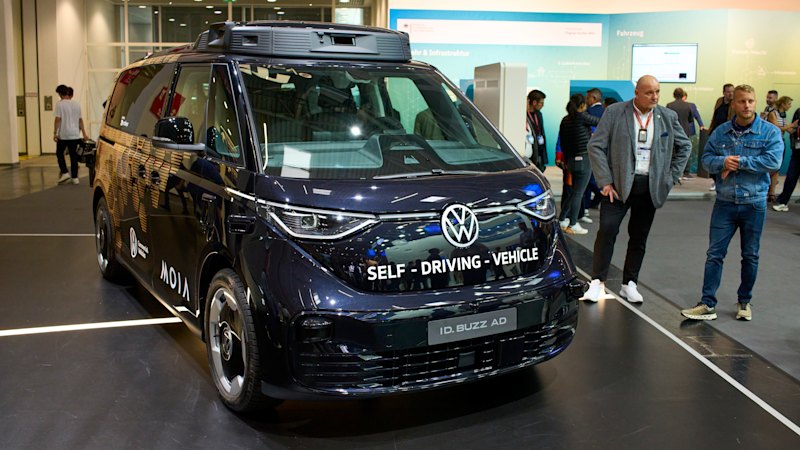
The fleet of specialized ID. Buzz electric vans used by Volkswagen incorporates an array of cameras and sensors. Unlike Waymo and Tesla, which utilize proprietary technology, the core systems for Volkswagen’s vehicles are derived from Israeli start-up Mobileye. Senger highlighted that there is significant potential in the commercial vehicle sector, predicting annual revenues from autonomous driving could exceed €10 billion (approximately $16.5 billion) within the next seven years.
“Volkswagen views this as an opportunity not to miss,” Senger stated, forecasting that the US and European markets for autonomous driving services could be worth between €350 billion and €450 billion by 2035.
Many legacy automakers have struggled to keep pace with the substantial investments needed to develop fully autonomous technologies. According to Stefan Bratzel, head of the Centre of Automotive Management, Volkswagen is currently the “only truly relevant competitor in the robotaxi race” among European companies, possessing a viable chance for a broad market rollout. He noted that Volkswagen’s local knowledge and partnership models could offer advantages, especially when integrating autonomous shuttles into public transport systems.
As Volkswagen enters a competitive market, it faces established players such as Waymo, which has logged over 125 million fully autonomous miles in the US with minimal safety incidents. Tesla has staked its future on artificial intelligence and autonomous driving, while Chinese manufacturers are increasingly investing in self-driving technologies.
Despite its ambitions, Volkswagen’s development is lagging behind Waymo, with its test vehicles having only covered approximately 1 million kilometres so far. Nevertheless, Volkswagen believes its deep understanding of the European market and the mapping data collected from its passenger vehicle fleet provide them with a competitive edge.
While MOIA’s vehicles currently require a driver present, a recent test drive in Hamburg demonstrated the vehicle’s ability to navigate challenging snowy conditions autonomously. Senger remarked, “We need to test where it’s very challenging… we will deploy where it’s easy,” highlighting the importance of rigorous testing in difficult environments.
Legacy automakers face difficulties keeping up with advancements made by tech giants in autonomous driving. Some analysts express skepticism about Volkswagen’s strategy, with UBS analyst Patrick Hummel suggesting that traditional car manufacturers might not play a significant role in the future of autonomous vehicles due to their lack of control over the underlying technology. He cautioned that these companies risk becoming suppliers of commodity hardware with very thin margins.
Volkswagen’s latest partnership with Uber in the US follows the abrupt shutdown of Argo AI, a self-driving vehicle group co-supported by Volkswagen and Ford in late 2022. In contrast, Mercedes-Benz has formed partnerships with China’s Momenta and taxi service Lumo to launch a luxury robotaxi service in Abu Dhabi, while continuing to collaborate with Uber and Nvidia for its own premium-class robotaxi development.
As Volkswagen seeks to sustain investment in autonomous technology, the company has indicated a willingness to adjust the ownership structure of its autonomous driving unit. This move aims to manage daily expenses while also addressing unseen costs associated with expansion. Senger emphasized, “If you are not able to scale, you will never get to the profits.”
The road ahead for Volkswagen in the self-driving vehicle sector will demand strategic partnerships, rigorous testing, and a keen understanding of both technological advancements and market dynamics.