



































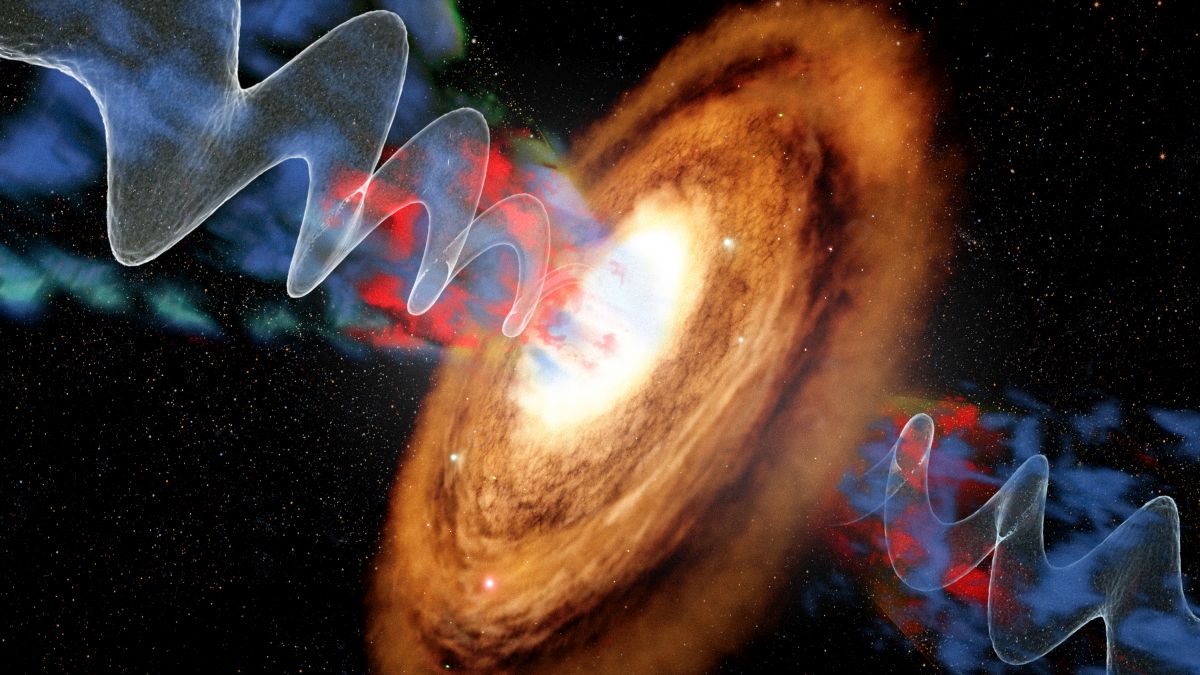
A team of astronomers has made a groundbreaking discovery regarding the spiral galaxy VV 340a, located approximately 500 million light-years from Earth. This galaxy has been observed ejecting vast streams of superheated material from the supermassive black hole at its center. Researchers indicate that this phenomenon could significantly impact the galaxy’s ability to form new stars.
The findings suggest that the black hole within VV 340a is expelling substantial amounts of material, thereby limiting star formation. According to Justin Kader, an astrophysicist from the University of California, Irvine, “To our knowledge, this is the first time we have seen a kiloparsec, or galactic-scale, precessing radio jet driving a massive coronal gas outflow.” Kader emphasized that this process is heating and removing star-forming gas essential for creating new stars.
Understanding Black Hole Feedback Mechanisms
Supermassive black holes play a crucial role in galaxy formation, but they also possess the capability to “starve” their host galaxies of necessary materials through intense radiation. This phenomenon indicates that a galaxy can transition to an inactive state, which does not necessarily indicate a permanent condition but marks the end of an active star-forming period.
The mechanisms by which black holes inhibit star formation are termed “feedback” and include powerful jets, radiation pressure, and winds generated as the black hole consumes surrounding matter. These jets are massive structures that emerge from the poles of actively feeding black holes. As the black hole consumes clouds of gas and dust, not all material crosses the event horizon. Some is redirected from the inner disk and propelled along magnetic field lines, resulting in high-speed jets that can extend for millions of light-years.
In the case of VV 340a, the jets have been observed extending approximately 20,000 light-years in each direction, composed of shock-heated, ionized gas. This material reaches temperatures akin to those found in the Sun’s outer atmosphere. Kader notes that the scale of these jets surpasses typical observations by a factor of over 30, as such energized gas is generally confined to a few tens of parsecs from the black hole.
Implications of the Discovery
Interestingly, while the jets from VV 340a are relatively large, they are not among the most forceful astrophysical jets. Nonetheless, they are estimated to be expelling mass equivalent to about 19.4 solar masses annually. In contrast, the Milky Way galaxy is known to produce around 3.3 solar masses of new stars each year.
The unique helical shape of VV 340a’s jets may enhance their efficiency in removing star-forming material from the galaxy. The jets exhibit precession, resembling a spinning sprinkler, which allows them to interact more effectively with the surrounding gas, heating it to temperatures not previously recorded at such distances from the black hole.
The discovery is particularly noteworthy as helical precessing jets are typically associated with older galaxies. VV 340a, however, is relatively young and currently merging with another galaxy. This merger could lead to a resurgence in star formation as the materials from both galaxies become shocked and compressed, creating optimal conditions for new stars.
“We are only beginning to understand how common this kind of activity may be,” stated Vivian U, an astronomer with Caltech. She expressed excitement about the potential for future discoveries, particularly with advanced observational tools like the James Webb Space Telescope (JWST).
The findings regarding VV 340a have been published in the journal Science, marking an important step in the ongoing exploration of the complex interactions between galaxies and their central black holes.
