


































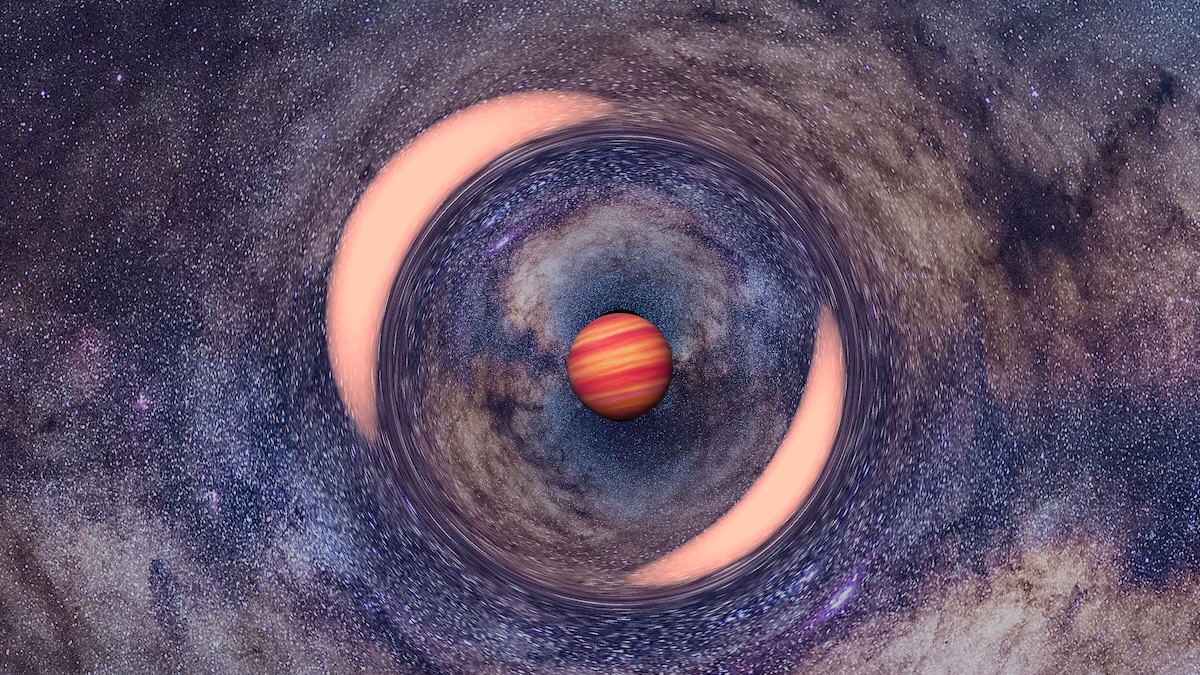
A team of astronomers has achieved a significant milestone by measuring the mass and distance of a rogue planet that orbits without a host star. This planet, located nearly 10,000 light-years from Earth in the direction of the Milky Way’s center, possesses approximately 22 percent of the mass of Jupiter. This groundbreaking discovery sheds light on the existence and characteristics of solitary planets in the universe.
Unveiling the Rogue Planet
Rogue planets, which drift through space unattached to any star, are typically challenging to detect due to their small size and dimness. Astronomers primarily identify such planets by observing their gravitational effects on light from distant stars. As a rogue planet passes in front of a bright background object, its gravitational influence creates a lensing effect, which temporarily magnifies or distorts the light.
In this instance, the astronomers were fortunate. The initial microlensing event was independently observed by multiple ground-based telescopes in Chile, South Africa, and Australia on May 3, 2024. Additionally, the retired Gaia Space Telescope monitored the event six times over a span of 16 hours. Gaia’s position, approximately 1.5 million kilometers from Earth, provided a unique perspective, allowing astronomers to gather crucial data on the planet’s distance and mass.
Innovative Techniques and Future Research
The astronomers calculated that the rogue planet is situated about 9,785 light-years from Earth. The advanced technique used for this measurement may hold promise for studying similar rogue planets in the future. In a perspective article, Gavin Coleman, an astrophysicist at Queen Mary University of London, stated that this method could become increasingly valuable with the launch of the Nancy Grace Roman Space Telescope in 2027.
“This finding demonstrates how coordinated observations can overcome difficulties in determining both the position and mass of a rogue planet and improve the understanding of how these planets form,” Coleman noted.
The upcoming Roman Space Telescope is designed to survey vast areas of the sky at speeds up to 1,000 times faster than the Hubble Telescope. This capability will enhance the likelihood of capturing additional gravitational lensing events, thereby expanding our knowledge of rogue planets and their formation.
The research detailing this discovery has been published in the journal Science, marking a significant contribution to the field of astronomy and our understanding of the universe’s solitary worlds.