



































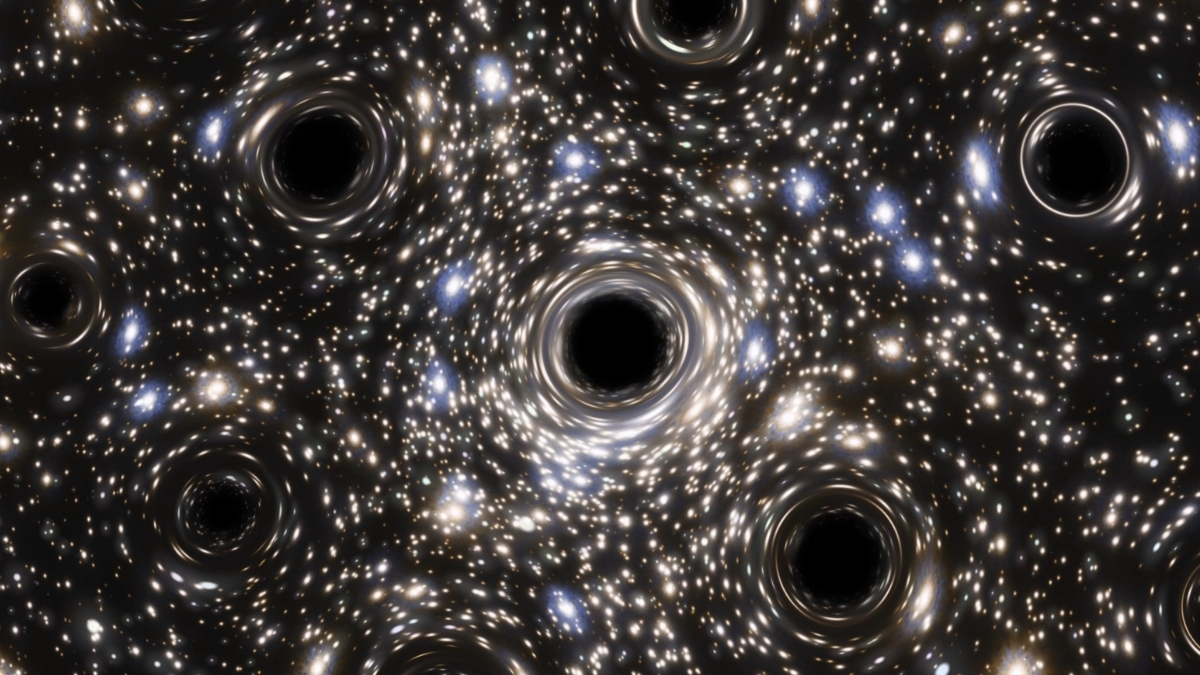
The European Space Agency’s Gaia mission has made a groundbreaking discovery by detecting a swarm of black holes moving through the Milky Way. This significant finding, reported in December 2023, adds a new dimension to our understanding of cosmic structures and the dynamics of our galaxy.
Recent observations from Gaia revealed the presence of over 100 black holes in the vicinity of our solar system. These black holes, remnants of massive stars that have undergone gravitational collapse, are believed to be traveling together in a cluster. This discovery could reshape theories about black hole formation and behavior within the Milky Way.
Implications for Astrophysics
The identification of these black holes has profound implications for the field of astrophysics. Researchers suggest that studying this cluster can provide insights into the life cycles of stars and the evolution of galaxies. As Gaia continues to monitor the area, scientists expect to gather more data about the black holes’ properties, such as mass and speed.
According to the lead researcher, Dr. Maria Rodriguez from the European Space Agency, “This discovery opens a window into the past and helps us understand how black holes interact and evolve in their environments.” The findings contribute to a growing body of evidence indicating that black holes are more common than previously thought.
The detection also raises questions about how these black holes may influence surrounding stellar environments. The gravitational pull of a black hole can impact the orbits of nearby stars, potentially leading to new star formation or even the ejection of stars from their systems.
Future Research and Exploration
Moving forward, the Gaia mission aims to refine its observations and investigate the broader implications of this discovery. The data collected will be essential for upcoming studies that seek to explore the relationship between black holes and other cosmic entities.
This discovery is part of a larger effort to map the Milky Way in unprecedented detail. Since its launch in 2013, Gaia has been instrumental in cataloging over 1.8 billion stars, providing a comprehensive understanding of our galaxy’s structure and composition.
The implications of finding a cluster of black holes extend beyond theoretical astrophysics. Understanding their distribution and behavior may also help scientists address fundamental questions about dark matter and the universe’s evolution. As research continues, the scientific community eagerly anticipates the next revelations from the Gaia mission.
In summary, the detection of a swarm of black holes by Gaia marks a significant milestone in astrophysics. This finding not only enhances our understanding of black holes but also sets the stage for future explorations of the Milky Way and beyond.