


































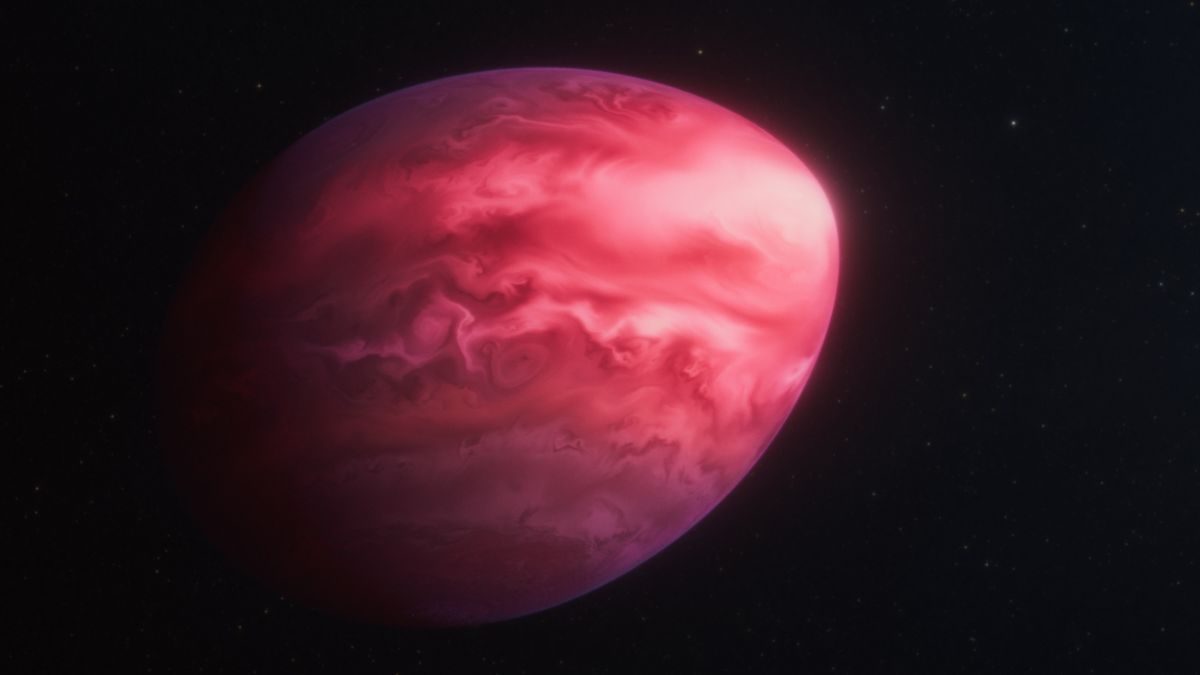
A newly discovered exoplanet, named PSR J2322-2650b, is captivating astronomers with its bizarre characteristics. Located approximately 2,055 light-years from Earth, this hot Jupiter has been stretched into a lemon shape due to the extreme gravitational forces exerted by its host star, a millisecond pulsar. The implications of this discovery challenge existing theories of planetary formation and evolution.
Astronomer Peter Gao from the Carnegie Earth and Planets Laboratory expressed his astonishment at the findings, stating, “This was an absolute surprise. I remember after we got the data down, our collective reaction was ‘What the heck is this?'” The unique atmosphere of PSR J2322-2650b is primarily composed of carbon vapor, and researchers speculate it may contain a helium-dominated interior. Notably, the atmosphere rotates in the opposite direction to the planet’s spin, adding to its peculiar nature.
Understanding the Pulsar and Planet Formation
The host star, PSR J2322-2650, is a type of neutron star that spins at astonishing speeds, emitting beams of radiation. This pulsar was identified in 2017 when astronomers observed irregularities in its radio pulses, indicating the presence of an unseen companion. This companion was later confirmed to be PSR J2322-2650b, with a mass roughly 80 percent that of Jupiter, completing an orbit around the pulsar every 7.8 hours.
The conditions surrounding PSR J2322-2650b are extreme. The intense gamma radiation from the pulsar heats its atmosphere to around 1,900 Kelvin (approximately 1,630 Celsius or 2,960 Fahrenheit), significantly higher than what would be expected from typical stellar heating. This has led to an atmosphere that is not only unique but also extremely dynamic, with winds moving against the planet’s rotational direction.
Challenging Existing Theories
Despite the advancements in exoplanet research, PSR J2322-2650b poses significant challenges to current models of planetary formation. Michael Zhang from the University of Chicago noted, “It’s very hard to imagine how you get this extremely carbon-enriched composition. It seems to rule out every known formation mechanism.”
The exoplanet’s atmosphere does not contain the typical molecules like water or methane; instead, it is rich in molecular carbon, specifically C3 and C2. This raises questions about the very nature of its formation. Researchers propose that PSR J2322-2650b may not have originated as a traditional planet but could have formed from a helium star that was eroded over time by its pulsar companion.
The interactions and conditions in this unique system underscore the complexity of planetary science and challenge assumptions about how planets and stars evolve. As Roger Romani, astrophysicist at Stanford University, pointed out, the ongoing research will help to unravel the mysteries surrounding this extraordinary exoplanet. “It’s nice to not know everything. I’m looking forward to learning more about the weirdness of this atmosphere,” he stated.
The findings related to PSR J2322-2650b have been published in The Astrophysical Journal Letters, contributing to the growing body of knowledge about the diversity of planetary systems in our universe. As more observations are conducted, scientists hope to gain deeper insights into the complexities of this unusual world and what it might reveal about the formation of planetary bodies across the cosmos.