



























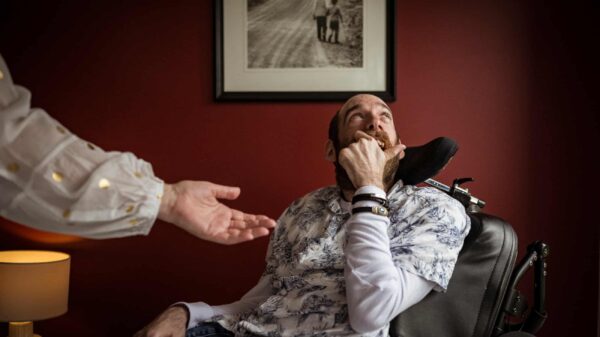


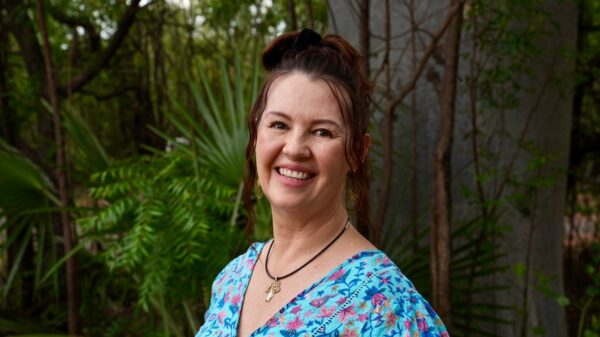


UPDATE: A groundbreaking achievement just occurred as Michaela Benthaus, a paraplegic engineer from Germany, has become the first wheelchair user to journey into space aboard Blue Origin‘s New Shepard rocket. The historic launch took place from West Texas, marking a significant leap for accessibility in space travel.
Benthaus, who was severely injured in a mountain biking accident seven years ago, lifted off alongside five other passengers, including former SpaceX executive Hans Koenigsmann, who played a crucial role in facilitating her dream flight. The mission, which soared to an altitude of over 105 km, lasted just under 11 minutes and provided Benthaus with an exhilarating taste of weightlessness.
“I laughed all the way up — it was the coolest experience,” Benthaus exclaimed after safely landing. The flight required only minor adjustments for her comfort, showcasing Blue Origin’s commitment to making space travel more inclusive. The capsule was designed with accessibility in mind, allowing a wider range of individuals to experience space.
To accommodate Benthaus, Blue Origin implemented a patient transfer board, enabling her to move from the hatch to her seat effortlessly. After landing, the recovery team laid out a carpet to ensure her quick access to her wheelchair, which she had left behind during the launch.
Benthaus, 33, is part of the European Space Agency’s graduate trainee program and has previously participated in a simulated space mission in Poland. She expressed her disbelief at being selected for this mission, stating, “I never really thought that going on a space flight would be a real option for me.” This flight represents a significant milestone not just for Benthaus, but for the future of space accessibility.
The flight also featured several business executives and investors, bringing Blue Origin’s list of space travelers to a remarkable 86 individuals. Although this was a private mission, it highlights the evolving landscape of space exploration, where individuals with disabilities can now have opportunities previously thought impossible.
Koenigsmann was designated as Benthaus’s emergency assistant, ensuring her safety during the mission. He echoed her enthusiasm, saying, “This is a monumental step for inclusivity in space travel.”
As space tourism continues to expand, this flight may pave the way for other individuals with disabilities to experience the wonders of space.
NEXT: Watch for updates on the broader implications of this flight as it sets a precedent for future missions. The European Space Agency has also made strides in inclusivity, clearing John McFall, an amputee, for future flights to the International Space Station.
This historic flight is not just a personal triumph for Benthaus but a beacon of hope for many aspiring astronauts with disabilities. The future of space travel is evolving, and the sky is no longer the limit.