



































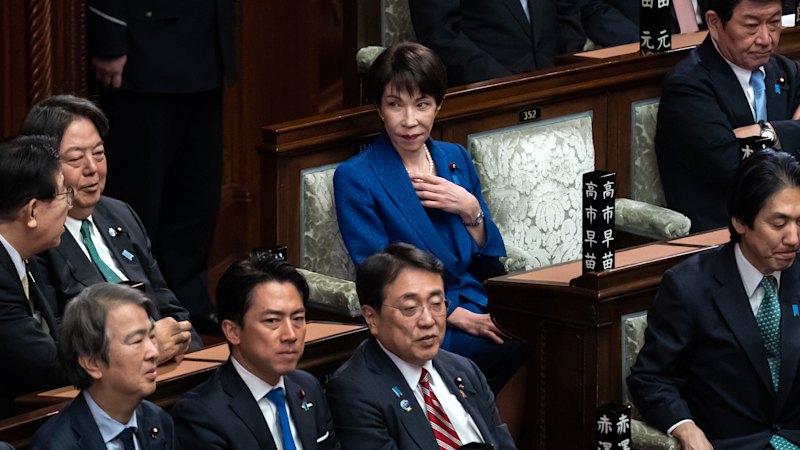
Japanese Prime Minister Sanae Takaichi has announced the dissolution of the lower house of parliament, setting the stage for an early election on February 8, 2026. This strategic move aims to capitalize on her current popularity, which boasts approval ratings of approximately 70 percent, as she seeks to strengthen her governing party, the Liberal Democratic Party (LDP), following significant losses in recent years.
Takaichi, who became Japan’s first female leader in October 2025, faces the challenge of advancing her party’s agenda while dealing with the fallout from past scandals, including corruption linked to the LDP and its connections to the Unification Church. Despite these hurdles, the political landscape remains fragmented, with the new opposition group, the Centrist Reform Alliance, still unable to consolidate enough support to pose a substantial threat to Takaichi’s party.
Takaichi’s leadership is also marked by rising tensions with China, particularly regarding her comments on Taiwan, the self-governing island that China claims as its own. The Prime Minister is under pressure from U.S. President Donald Trump to increase Japan’s military spending amidst these regional tensions.
The dissolution of the 465-member House of Representatives initiates a 12-day campaign, officially commencing on Tuesday. When the dissolution was announced by Speaker Fukushiro Nukaga, lawmakers celebrated with shouts of “banzai,” meaning “long live,” as they prepared for the upcoming election.
Takaichi’s early election strategy aims to secure a governing majority in the lower house of the National Diet, Japan’s bicameral parliament. Following a disappointing showing in the 2024 elections, the LDP and its coalition partners currently hold only a slim majority in the lower house, while lacking a majority in the upper house. This situation leaves the coalition reliant on support from opposition members to pass key legislation.
Opposition leaders have criticized Takaichi for delaying the approval of a crucial budget aimed at fostering economic recovery and addressing rising prices. During a press conference announcing the election, Takaichi stated, “I believe that the only option is for the people, as sovereign citizens, to decide whether Sanae Takaichi should be prime minister.” She emphasized her commitment to her role, declaring, “I’m staking my career as prime minister” on this election.
A hard-line conservative, Takaichi intends to underscore her differences from her centrist predecessor, Shigeru Ishiba. She is advocating for fiscal policies that include increased military spending and stricter immigration measures, asserting the need for Japan to become “strong and prosperous.” Despite her strong personal appeal, the LDP continues to grapple with its public image, particularly in light of recent scandals that have driven traditional supporters towards far-right populist alternatives, such as the anti-globalist Sanseito party.
As Japan navigates escalating tensions with China, Takaichi aims to bolster military capabilities and defense spending, responding to both domestic and international pressures. Her administration’s focus on national security is mirrored in her partnership with the Japan Innovation Party (JIP), with which she has aligned over shared goals, including military enhancement and energy policy reform.
The LDP’s former coalition partner, Komeito, recently distanced itself over Takaichi’s ideological stance and her reluctance to pursue anti-corruption initiatives, prompting Komeito to collaborate with the Constitutional Democratic Party of Japan to form the Centrist Reform Alliance just ahead of the elections. This new alliance seeks to promote a diverse, gender-equal society and aims to present a “realistic” security policy while advocating for a nuclear weapons-free world.
Despite the challenges ahead, Takaichi is focusing on economic issues to sway voters, proposing measures to combat rising prices and stagnant wages, and offering support for low-income households. Her party’s new immigration policies include stricter requirements for foreign property owners and a cap on the number of foreign residents, reflecting growing concerns over anti-foreign sentiment in Japan.
As the election approaches, Takaichi’s political future hangs in the balance. With public sentiment fluctuating and opposition parties still fragmented, the outcome remains uncertain. Yet, she remains resolute in her mission to secure a mandate for her policies and to reaffirm her leadership in a complex political landscape.