
































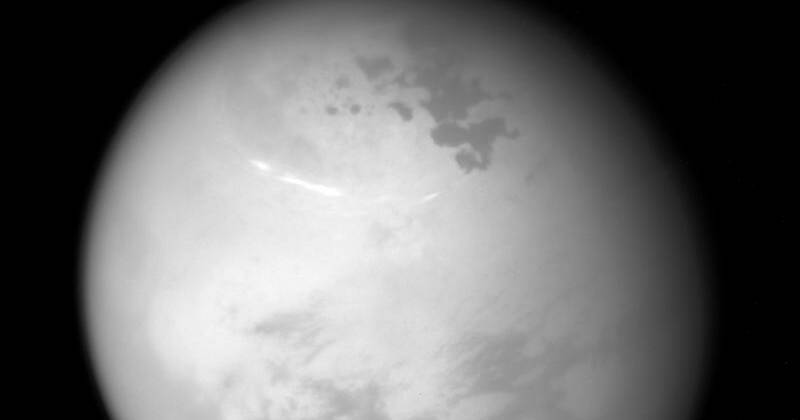
Recent research suggests that Saturn’s moon Titan may not possess the vast underground ocean previously assumed. Instead, scientists now believe that Titan consists of deep layers of ice and slush, resembling Earth’s polar seas, with potential pockets of melted water. This new perspective challenges a decade-long hypothesis about Titan’s hydrosphere, based on a reevaluation of data gathered by NASA’s Cassini spacecraft.
The study, led by researchers at NASA’s Jet Propulsion Laboratory (JPL), highlights that while no signs of life have been detected on Titan, which spans 5,150 km and is known for its lakes of liquid methane, the findings warrant optimism regarding the moon’s potential for hosting extraterrestrial life. Baptiste Journaux, a researcher from the University of Washington, emphasized that the latest data indicates a slushy environment that could support life, although it may be strictly microscopic. He noted, “Nature has repeatedly demonstrated far greater creativity than the most imaginative scientists.”
The research suggests that Titan’s ocean may have frozen in the past and is currently undergoing a melting process, or it may be evolving towards complete freezing. According to computer models, the layers of ice and slush could extend to depths exceeding 550 km, with an outer ice shell approximately 170 km deep. Below this ice layer, pools of water may reach temperatures as warm as 20°C.
Titan’s unique characteristics include being tidally locked to Saturn, meaning the same side of the moon consistently faces the planet. This gravitational pull creates surface deformations that can bulge by as much as 10 metres when Saturn and Titan are closest. The JPL team, led by Flavio Petricca, utilized advanced data processing to analyze the timing of Titan’s surface movement in relation to Saturn’s gravitational tug. They found a delay of 15 hours between the gravitational peak and the surface rise, indicating an interior composed of slushy ice rather than a liquid ocean.
Despite these findings, some scientists remain skeptical. Luciano Iess from Sapienza University of Rome, whose earlier studies indicated the presence of a hidden ocean, described the results as “certainly intriguing” but stated that the current evidence does not sufficiently exclude Titan from the category of ocean worlds.
Looking ahead, NASA’s upcoming Dragonfly mission, set to launch later this decade, is expected to provide deeper insights into Titan’s geological and potentially biological characteristics. This innovative mission features a helicopter-type craft designed to explore various locations on the moon’s surface, aiming to shed light on its complex environment.
As researchers continue to investigate Titan, the moon remains a focal point of interest for astrobiologists and planetary scientists alike, with its intriguing blend of icy terrain and the possibility of life in its subsurface layers. The ongoing studies underscore a shifting understanding of Titan, inviting further exploration of this distant celestial body.