



























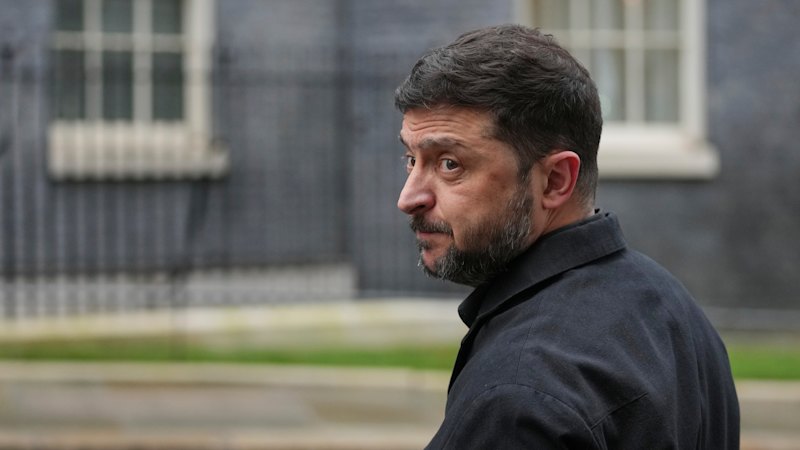
Ukrainian President Volodymyr Zelensky signaled a potential shift in Ukraine’s military strategy, indicating a willingness to withdraw troops from the eastern region of Donbas as part of a broader peace plan. This proposal hinges on a reciprocal pullback by Russia, aiming to establish a demilitarised zone that would also function as a free economic area monitored by international forces.
During a press conference, Zelensky articulated the need for substantial compromises concerning the Donbas, where control remains a significant barrier in peace negotiations. He noted that similar arrangements could be considered for the area surrounding the Zaporizhzhia nuclear power plant, currently under Russian control. Zelensky emphasized that any peace plan would ultimately require a referendum to ensure public buy-in.
The Ukrainian leader’s remarks followed a series of discussions held in Florida between U.S. negotiators and Ukrainian representatives, resulting in a 20-point framework for negotiations. While Zelensky acknowledged that many details are still under consideration, the discussions mark a crucial step in addressing the ongoing conflict that has persisted since Russia’s invasion nearly four years ago.
Despite Zelensky’s proposals, the Kremlin has shown no inclination to withdraw its forces from seized territories. Dmitry Peskov, spokesperson for the Kremlin, stated that Russia’s position will be shaped by information from presidential envoy Kirill Dmitriev, who recently met with U.S. officials. Peskov did not elaborate on specific details of the discussions.
The ongoing tensions in Donbas, where Russia has secured control over most of Luhansk and approximately 70 percent of Donetsk, complicate the peace process. Zelensky described the negotiations regarding the Donbas region as “the most difficult point” in the discussions.
In addressing the situation at the Zaporizhzhia nuclear power plant, Zelensky proposed a joint venture involving the U.S. and Ukraine, where the U.S. would have autonomy over energy distribution, while Russia would be allocated a share. He criticized the U.S. proposal for joint control among the three parties as “not entirely realistic,” given the current geopolitical climate.
Zelensky stressed the necessity of establishing a free economic zone in Donbas, which would require challenging negotiations about troop movements and the deployment of international forces. He suggested that international observers be positioned along specific points of the contact line to ensure compliance with the agreement.
The draft agreement also outlines the withdrawal of Russian forces from the regions of Dnipropetrovsk, Mykolaiv, Sumy, and Kharkiv. Zelensky expressed the need for international forces to monitor this newly established economic zone, citing a lack of trust in Russian commitments. He remarked, “Since there is no faith in the Russians, and they have repeatedly broken their promises, today’s contact line is turning into a line of a de facto free economic zone.”
Additionally, Zelensky conveyed that the city of Enerhodar, closest to the nuclear facility, should also be designated as a demilitarised free economic zone. He noted that discussions regarding this point with the U.S. required extensive dialogue but concluded without consensus.
The U.S. has suggested a framework where the Zaporizhzhia plant would be jointly operated by Ukraine, the U.S., and Russia, with each party holding a one-third stake. Zelensky countered that this arrangement is impractical, questioning the feasibility of commercial cooperation with Russia under the current circumstances.
To restore operations at the power plant, significant investments are needed, particularly for the rehabilitation of the adjacent dam. The agreement draft promises robust security guarantees for Ukraine, mirroring NATO’s Article 5, which stipulates that an attack on one member is considered an attack on all.
Zelensky stated that a separate document with the U.S. will outline these security guarantees, detailing the conditions under which support would be provided in the event of renewed Russian aggression. He characterized the shift in U.S. stance as a groundbreaking step towards Ukraine, indicating that they believe they are offering substantial security assurances.
The comprehensive agreement also includes provisions to maintain Ukraine’s military strength at 800,000 personnel during peacetime and sets a timeline for Ukraine’s accession to the European Union. This military limitation is a pivotal demand from Russia, illustrating the complexities of reaching a viable peace agreement.