














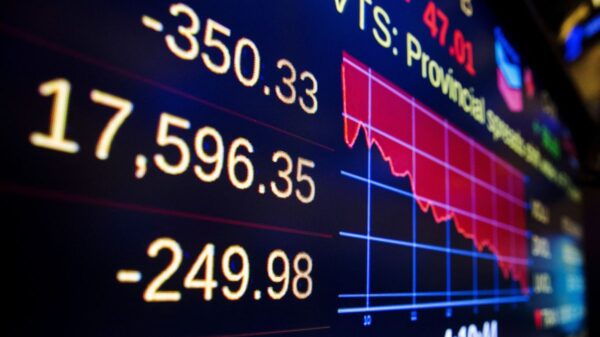





















U.S. stock futures experienced a significant downturn on March 2, 2026, driven by escalating military tensions in the Middle East. Investors reacted sharply to the recent joint strikes by the United States and Israel on Iran, leading to a widespread flight to safety. The Dow Jones Industrial Average futures fell by more than 500 points, translating to a decline of approximately 1.2%. Similarly, S&P 500 futures dropped around 1.1%, while Nasdaq 100 futures slid by 1.4%.
Market Reaction and Investor Sentiment
The market’s swift response indicated a volatile opening for Wall Street, as evidenced by the CBOE Volatility Index (VIX) climbing to a three-month high near 23.7, reflecting growing investor anxiety. This geopolitical shock compounded existing pressures, including uncertainties related to artificial intelligence, rising inflation data, and concerns surrounding private credit. President Donald Trump suggested that military operations in Iran could extend for several weeks, raising fears of prolonged disruptions to global trade and energy supplies, along with increasing inflationary pressures.
As a result of these tensions, crude oil prices surged significantly. The U.S. benchmark, West Texas Intermediate, experienced an increase of approximately 8-9%, nearing $73 per barrel, while Brent crude prices jumped almost 10%, approaching $80. Energy stocks are expected to benefit, particularly North American producers. However, the broader market faced pressures, notably in sectors like airlines, which reported halting flights in the region.
Demand for safe-haven assets rose sharply, with gold and silver futures showing gains. The yield on the 10-year Treasury note edged upwards to about 3.99%, reflecting changing expectations for borrowing costs due to potential inflation driven by energy price shocks.
February Performance and Future Outlook
The sell-off extended from the previous close on February 28, when major indexes concluded the month on a downward trend. The Dow Jones Industrial Average fell by 521.28 points, or 1.05%, finishing at 48,977.92. The S&P 500 decreased by 0.43% to 6,878.88, while the Nasdaq Composite lost 0.92%, closing at 22,668.21. February proved challenging for the stock market, with the Nasdaq and S&P 500 experiencing their worst monthly performances since March in recent years. In contrast, the Dow managed slight gains, marking its tenth consecutive month of positive performance.
Analysts have noted the market’s vulnerability to geopolitical developments. According to Reuters, futures slipped over 1% as investors accounted for a potential weeks-long conflict that could disrupt supply flows. USA Today reported significant impacts on airlines and financial sectors due to the uncertain global outlook.
Despite the immediate pressures, some analysts maintain optimism for March. Tom Lee from Fundstrat, during a recent appearance on CNBC, predicted that March typically sees upward movement in stocks, averaging gains of 1.0% with a 64% occurrence over the past five decades. He suggested that the current market dip might be temporary, buoyed by ongoing momentum in AI and economic resilience.
Data from Trading Economics indicated that the S&P 500 index dipped to between 6,798 and 6,806 points on March 2, reflecting a decrease of 1.06-1.52% in recent sessions. However, it remains significantly up year-over-year, approximately 16%. After reaching an all-time high of nearly 7,002 in January, the index has faced pullbacks due to market volatility. Recent sector rotations have favored defensive and commodity stocks, with healthcare, energy, and consumer staples performing well, while technology and financial sectors lagged.
As tensions continue, defense contractors have gained traction, with prospects for further growth should the conflict escalate. Markets in Europe and Asia also reacted negatively, particularly in energy-sensitive regions. Cryptocurrency markets saw Bitcoin hovering around $66,000 after experiencing a dip below $63,000 over the weekend.
Investors are now closely monitoring upcoming data releases and remarks from the Federal Reserve for insights into potential interest rate paths. Nonetheless, geopolitical developments are dominating the narrative. The duration and scope of the conflict could significantly impact near-term market directions, with supply chain risks and inflation concerns at the forefront.
As Wall Street prepares for a tumultuous trading atmosphere, the interplay between energy and defense sector gains and broader market declines will be key to navigating ongoing uncertainties. Long-term investors point to historical trends supporting March as a month of strength, driven by advancements in AI. Yet, in the short term, caution prevails as the risk-off sentiment takes hold of market dynamics.