































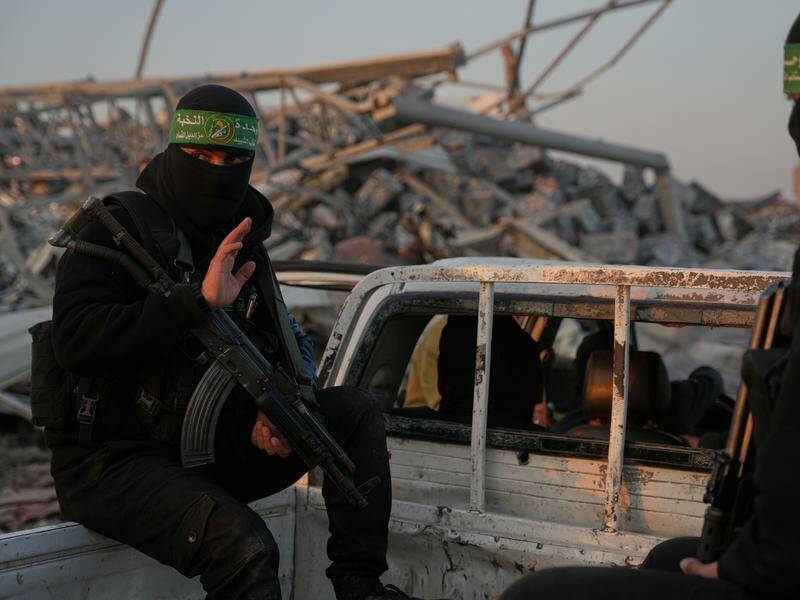
An Israeli-backed Palestinian militia has claimed responsibility for the killing of a senior Hamas police officer in the southern Gaza Strip. The victim, Mahmoud Al-Astal, served as the head of the criminal police unit in Khan Younis. His death has heightened tensions in an already volatile region, with Hamas attributing the attack to “Israeli collaborators.”
According to a statement from the Hamas-run interior ministry, gunmen opened fire from a passing vehicle, fatally striking Al-Astal. The ministry condemned the attackers, labeling them as “collaborators with the occupation.” In a video posted on social media, Hussam Al-Astal, a leader of an anti-Hamas group operating in an area under Israeli control, took credit for the attack, threatening further violence against those associated with Hamas.
The circumstances surrounding the incident remain unclear, as Reuters has not independently verified the details. An Israeli military official stated that they were not aware of any operations in the area at the time.
The emergence of armed anti-Hamas groups, although limited in size, has begun to exert pressure on Hamas. These factions complicate efforts to stabilize and unify Gaza, which has been fractured by ongoing conflict. Despite their activities, these groups face unpopularity among local residents, as they operate in territories under Israeli control. They publicly deny receiving directives from Israeli authorities.
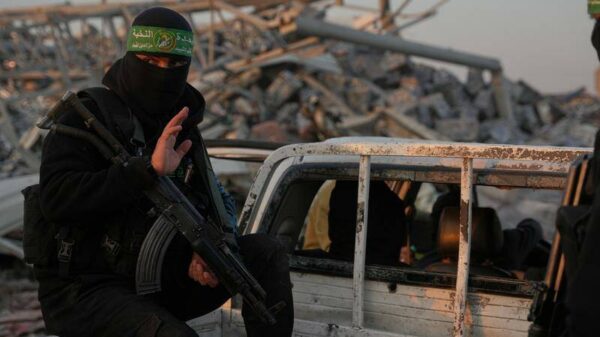
Hamas has responded to perceived threats by conducting public executions of individuals accused of collaboration. Since a ceasefire was established in October, Israel has withdrawn from nearly half of the Gaza Strip, though military presence remains in other areas, most of which have been devastated by conflict. Nearly all of Gaza’s two million residents now inhabit Hamas-controlled zones, often in makeshift shelters or damaged buildings, as the group reasserts its authority.
Despite suffering significant losses during the recent war, Hamas reportedly still commands thousands of fighters, according to several sources within the organization. Israel has permitted rival factions to operate within areas it controls, reflecting a complex dynamic in the region.
In June, Israeli Prime Minister Benjamin Netanyahu acknowledged support for anti-Hamas groups, stating that Israel had “activated” local clans. However, specific details on this support have been sparse. The ceasefire, which has largely halted major combat operations in Gaza for three months, has not eliminated hostilities entirely. Both sides have accused one another of violating the terms of the truce.
Since the ceasefire took effect, over 440 Palestinians and three Israeli soldiers have reportedly lost their lives. On Monday, Gaza health authorities reported that Israeli drone strikes resulted in the deaths of at least three individuals near the center of Khan Younis. The Israeli military claimed these individuals were militants approaching their forces and stated they acted to “remove the threat.”
Tensions escalated significantly on October 7, 2023, when militants from Gaza invaded Israel, resulting in approximately 1,200 Israeli fatalities and the abduction of around 250 hostages. In retaliation, Israel launched a military campaign in Gaza, which has reportedly resulted in over 71,000 Palestinian deaths, according to the enclave’s health ministry. The conflict has drawn international condemnation, with accusations of war crimes directed at Israel, which it has firmly denied.