


































Recent research led by the Flatiron Institute in the United States has produced groundbreaking simulations that enhance our understanding of how stellar-mass black holes consume and expel matter. These simulations, developed using advanced computational techniques, provide significant insights into the chaotic environments surrounding black holes, which are traditionally challenging to model due to their complex physics.
The study focuses on the accretion processes occurring near black holes, where matter is drawn in at varying rates, often accompanied by bursts of radiation. Previous models relied on simplifications that limited their accuracy. In contrast, this new research employs two powerful supercomputers to integrate observational data with detailed measurements of black hole spin and magnetic fields. The result is a more sophisticated representation of the dynamics at play in these extreme environments.
Revolutionary Simulations Change Understanding of Black Hole Behavior
Astrophysicist Lizhong Zhang from the Flatiron Institute emphasizes the importance of this study, stating, “This is the first time we’ve been able to see what happens when the most important physical processes in black hole accretion are included accurately.” The findings indicate that these systems are highly nonlinear, meaning that even minor oversimplifications can lead to drastically different outcomes.
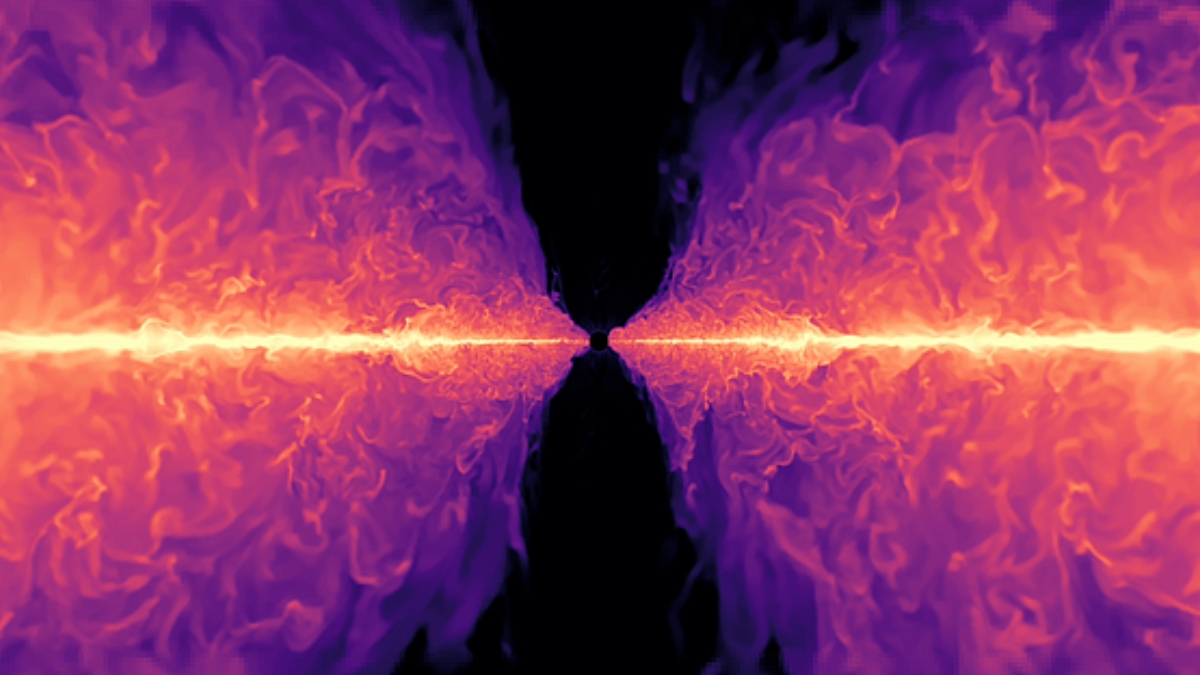
The research aligns with existing observations of various black hole systems, despite challenges in capturing light from smaller black holes. The simulations reveal that black holes can build up dense accretion disks that absorb large amounts of radiation, subsequently releasing energy through winds and jets. Notably, the team discovered that a narrow funnel forms around the black hole, allowing it to draw in material at remarkable rates and emit radiation that is observable only from certain angles.
Additionally, the study highlights the role of the surrounding magnetic field in directing the flow of gas towards the black hole’s event horizon. This magnetic influence aids in the formation of jets and winds, further complicating the dynamics of black hole behavior.
Future Directions and Broader Implications
The researchers plan to extend their simulations to explore other types of black holes, such as the Sagittarius A* supermassive black hole located at the center of the Milky Way. They believe their findings could also shed light on the enigmatic ‘little red dots’ recently identified by astronomers, which emit less X-ray radiation than anticipated.
The team asserts that while their current models are tailored to stellar-mass black holes, many fundamental aspects of their results could also apply to accretion processes involving supermassive black holes. This research has been published in The Astrophysical Journal, marking a significant step forward in astrophysical modeling and understanding of black hole dynamics.
The implications of this study extend beyond theoretical physics, as they could influence future observational strategies and improve our understanding of the universe’s most mysterious objects. As the research community continues to explore these enigmatic celestial phenomena, the insights gained from these simulations will undoubtedly play a crucial role in shaping our knowledge of black holes and their impact on the cosmos.